



August 11, 2026
Packaging Recyclability Labels Explained: How2Recycle, OPRL, ARL and How to Get Them on Your Pack
Walk down any supermarket aisle and the recycling symbols on packaging are everywhere. The Mobius loop, the Tidyman, the Green Dot, the chasing arrows with a resin code. Most of them say very little about whether the packaging can actually be recycled. In most markets, the only symbols that do are the ones issued by formal recyclability labelling schemes.
Recyclability labelling schemes — How2Recycle in North America, the Australian Recycling Label (ARL) in Australia and New Zealand, OPRL in the UK, and Triman in France — are the systems that assess whether a packaging format is actually collected and processed through recycling infrastructure in a given market, and award on-pack labels on that basis. They are the difference between a recycling symbol that means something and one that does not.
This guide covers the four main recyclability labelling systems operating in English-language markets: what each one actually certifies, which markets it applies in, how to get onto the programme, and the other symbols commonly found on packaging that are frequently mistaken for recyclability labels.
Quick answer: what are the main packaging recyclability labelling systems?
There are four major recyclability labelling systems operating across English-language markets.
- How2Recycle (US and Canada) is managed by GreenBlue and assigns one of four recyclability designations based on US collection infrastructure.
- APCO's Australasian Recycling Label (ARL) uses a three-tier system assessed through the PREP tool.
- OPRL (UK) licences the On Pack Recycling Label to brands based on WRAP collection data.
- France's Triman is a mandatory EPR contribution mark rather than a voluntary recyclability label, and operates under different rules from the other three.
These systems are market-specific and not interchangeable.
Why recyclability labelling matters commercially
Recyclability is the most important sustainability characteristic consumers look for in packaging, consistently across every major market. That preference creates real commercial stakes for how labelling is handled.
There are three direct business reasons to get this right:
- EPR eco-modulation. In the UK, OPRL-labelled packaging is factored into fee modulation under the 2025 EPR scheme. In the US, How2Recycle assessment is increasingly referenced by state EPR programmes when classifying packaging recyclability. Correct labelling can reduce your fee liability. Incorrect or absent labelling leaves credits on the table.
- Regulatory compliance. FTC Green Guides (US), the EU Green Claims Directive (2026), and UK ASA guidelines all require recyclability claims to be substantiated and accurate. Unsubstantiated claims now carry enforcement risk, not just reputational risk. Read more on Packaging Greenwashing Laws.
- Consumer trust. A 2026 systematic review of the research literature identified trust in labelling as one of the key determinants of consumer purchasing behaviour toward sustainable packaging. Credible, recognised labels build that trust. Vague or incorrect claims erode it.
The four main recyclability labelling systems
How2Recycle (US and Canada)
What it is
How2Recycle is a voluntary standardised labelling system managed by GreenBlue, a US non-profit. It is the most widely recognised recyclability label in the US market and is used by major CPG brands across food, beverage, personal care, and ecommerce. It is accepted by all major US retailers as the standard for recyclability claims on packaging.
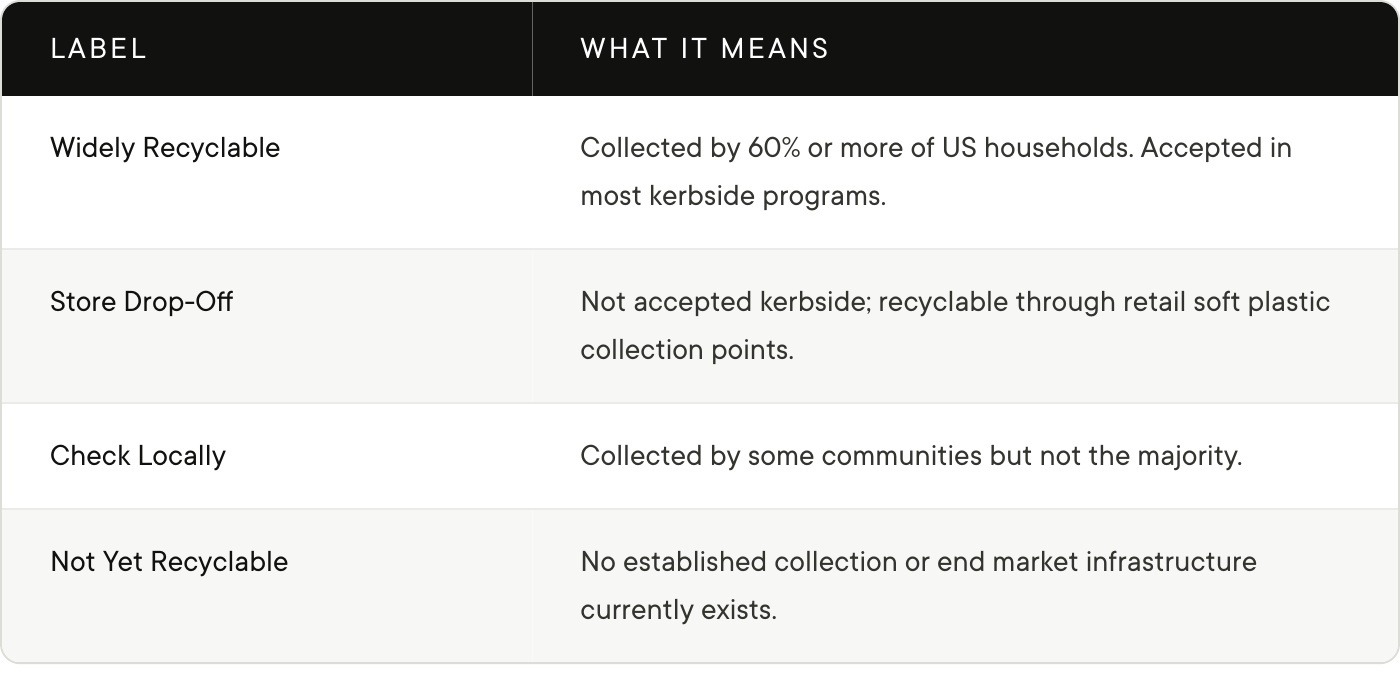
Each label includes the specific material type (e.g., "PE film," "corrugated cardboard") and any consumer action required (e.g., "empty and replace cap"). The Store Drop-Off label is the most relevant designation for most flexible packaging formats, given that soft plastics are typically not accepted kerbside in the US.
How How2Recycle labels on your packaging
- Join the How2Recycle programme at how2recycle.info. Membership is required; it is not a free-to-use label.
- Pay the annual membership fee. Fees are tiered by company revenue, starting around USD 2,000 per year for smaller brands and scaling for larger organisations.
- Submit each packaging SKU for assessment through the How2Recycle member portal. Each component (pouch, lid, label, closure) is assessed separately.
- The assessment evaluates whether the material is collected, sorted, and has viable end markets in 60% or more of US communities. GreenBlue reviews the data and assigns a designation.
- Download approved label artwork from the portal.
- Apply the label to packaging artwork, following How2Recycle's on-pack placement guidelines.
- Reassess when your packaging format changes, or when How2Recycle updates its methodology or infrastructure data.
Watch-outs
The Store Drop-Off label requires active verification that a sufficient network of qualifying store drop-off locations exists in the markets where you sell. How2Recycle audits this periodically. If infrastructure changes (for example, if a major retailer removes its soft plastic collection programme), your label designation may need to be updated.
How2Recycle also operates in Canada under the same programme, with Canadian collection infrastructure incorporated into assessments for brands selling across both markets.
APCO Australasian Recycling Label (ARL)
What it is
The Australasian Recycling Label is managed by APCO, the Australian Packaging Covenant Organisation. It is the standard recyclability label for Australia and New Zealand, and its adoption has accelerated significantly as EPR obligations under Australia's 2025 National Packaging Targets have increased.
The ARL assessment tool (PREP: Packaging Recyclability Evaluation Portal) is free to use for active APCO members.
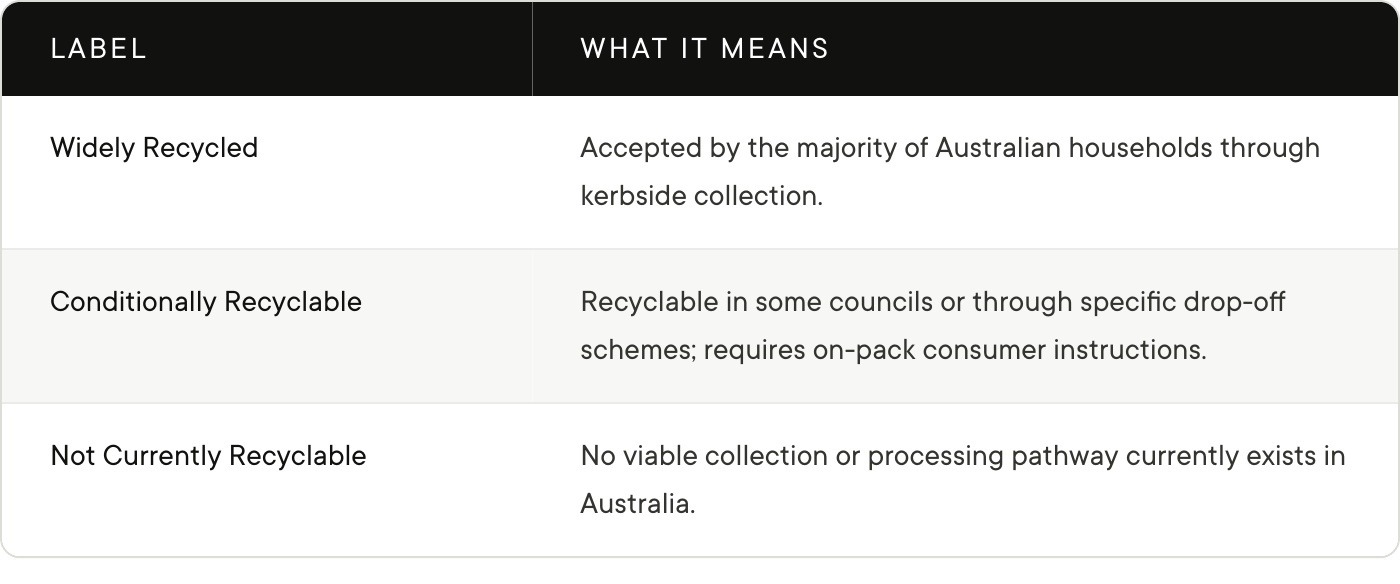
Flexible plastic packaging is typically classified as Conditionally Recyclable under current ARL assessments, reflecting the state of Australian soft plastic collection infrastructure following the collapse of the REDcycle programme and the establishment of new replacement schemes.
How to get it on your packaging
- Register at prep.apco.org.au. The use of the PREP assessment tool is free for APCO members.
- Enter each packaging component separately: material type, format, and any additional attributes such as barrier coatings, inks, or adhesive labels.
- PREP assesses each component against current Australian collection and processing data. The overall pack result reflects the component with the most restrictive outcome.
- The tool generates a recommended ARL label tier for each component and the overall pack.
- Download ARL label artwork from the APCO website. Artwork is available in multiple formats.
- Apply the label to packaging following APCO's on-pack guidelines. Each label must include the material type and, for Conditionally Recyclable formats, the specific consumer instruction (e.g., "soft plastic drop-off").
- Reassess when packaging changes or when APCO updates its infrastructure data, typically annually.
Watch-outs
PREP assessments are based on current Australian infrastructure data, which changes as collection programmes develop. The soft plastic recycling landscape in Australia is evolving following the REDcycle collapse, and ARL outcomes for flexible formats are likely to improve as replacement infrastructure scales. Reassessing periodically is important to ensure your label remains accurate and does not understate recyclability as infrastructure improves.
APCO membership is separate from PREP access. APCO membership is recommended for brands with significant Australian packaging volumes, as signatories to the Australian Packaging Covenant benefit from regulatory engagement and reporting support.
OPRL On Pack Recycling Label (UK)
What it is
OPRL is a not-for-profit company that manages the On Pack Recycling Label scheme for the UK. It is the standard recyclability label for UK consumer packaging and is used by major retailers and CPG brands across all categories. OPRL labelling is directly referenced in the UK's 2025 EPR scheme: correct OPRL labelling is a factor in eco-modulation fee calculations, which creates a direct financial incentive to assess and label packaging accurately.
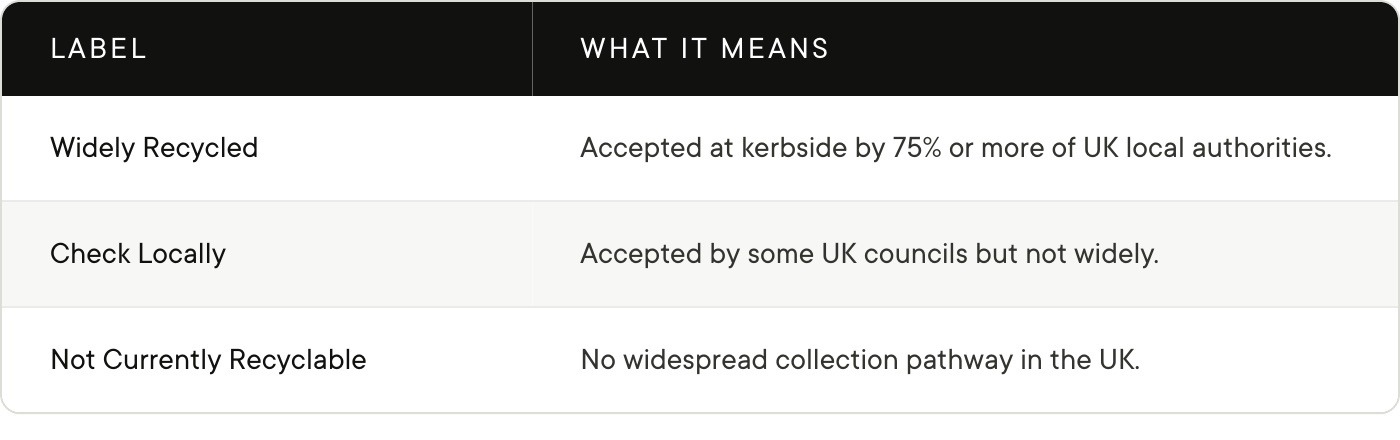
The "Widely Recycled" threshold of 75% is notably higher than the US How2Recycle threshold of 60%, meaning some formats that qualify as Widely Recyclable in the US will not qualify for the equivalent UK designation.
OPRL also publishes supporting guidance for flexible packaging formats specifically, given the developing state of kerbside soft plastic collection across UK local authorities.
How to get it on your packaging
- Review OPRL's Recyclability Assessment Guidance and the supporting material-specific datasets at oprl.org.uk. OPRL publishes the criteria and data used in assessments.
- Assess each packaging component against the current OPRL criteria. This can be done by the brand directly using OPRL's published data, or by engaging an OPRL-approved assessment body.
- Determine the correct label designation based on current UK local authority collection rates for the specific material and format.
- Apply for a licence to use the OPRL label. Licensing is required; OPRL is not a free-to-use label. Licence fees are based on annual turnover and are available at oprl.org.uk.
- Download licensed label artwork and apply to packaging following OPRL's technical specifications.
- Review labelling annually. OPRL updates its infrastructure data in line with WRAP research on UK kerbside collection, and label designations can change as infrastructure develops.
Watch-outs
OPRL updated its assessment criteria in 2024 to reflect the improving landscape for some flexible packaging formats. If you last assessed your packaging before 2024, it is worth reassessing. Some formats that previously received a Check Locally or Not Currently Recyclable designation may now qualify for a higher tier.
Non-UK brands selling into the UK market can use OPRL in the same way as UK-based brands. The licence covers use of the label regardless of where the brand is incorporated.
France: Triman and Info-tri
What it is, and what it is not
The Triman logo is mandatory in France for all consumer products subject to an EPR obligation, including packaging. It has been required since January 2022. This is a fundamentally different system from How2Recycle, the ARL, and OPRL. Triman is not a recyclability assessment label, it is an EPR contribution mark. It signals that the producer has registered with a Producer Responsibility Organisation and that the product is within scope of France's EPR system. It does not mean the packaging is recyclable.
Alongside Triman, Info-tri provides the specific sorting instruction: which bin or drop-off point the consumer should use for each packaging component. From 2025, sorting instructions must appear on-pack physically (not only digitally) for most packaging categories.
How to comply
- Register with a PRO for household packaging in France. CITEO is the main PRO for this category.
- Non-EU brands must appoint a French-based mandataire (authorised representative) before registering with CITEO. Non-EU brands cannot self-register.
- Pay EPR fees to CITEO based on the volume and type of packaging you place on the French market.
- Download the Triman logo from ADEME's official resource library. The logo is free to use once you are registered with a PRO.
- Apply the Triman logo to all consumer packaging sold in France.
- Add Info-tri sorting instructions to packaging. These must follow France's official national sorting guidelines, which are updated periodically by ADEME and CITEO.
Watch-outs
Triman is a legal compliance requirement, not a voluntary choice. Non-compliance carries fines. For brands selling into France for the first time, the mandataire appointment step is often overlooked; it is a prerequisite for the entire process and must be completed before registration with CITEO can proceed.
The Info-tri instructions must be accurate. Using incorrect sorting instructions (for example, instructing consumers to place packaging in the yellow bin when the format is not recycled through that stream in France) creates greenwashing liability under French consumer protection law.
Other marks on packaging: what they mean and what they do not
This table covers symbols commonly found on packaging that are frequently confused with recyclability labels. None of the following constitute a recyclability certification.
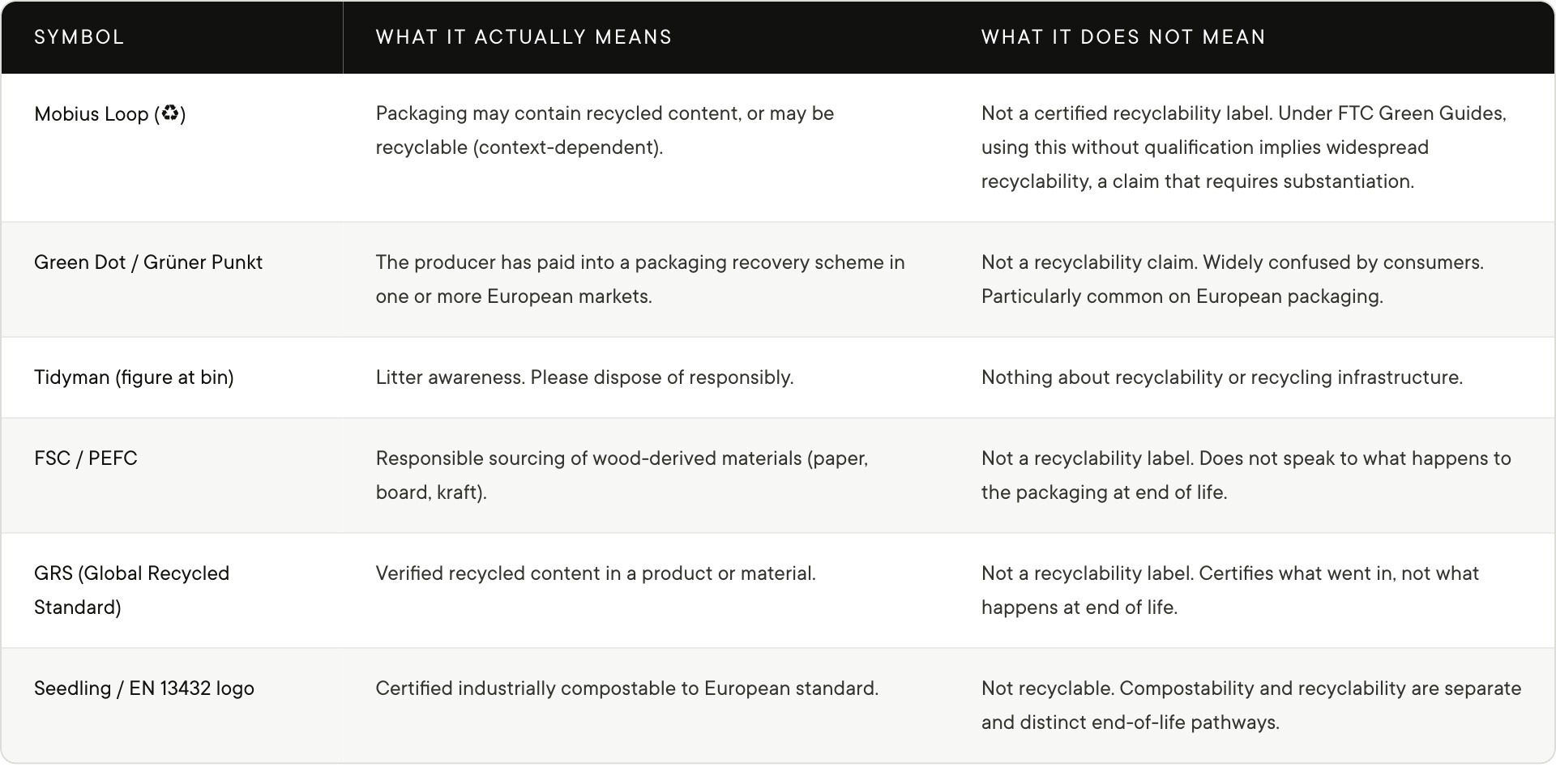
The Mobius Loop deserves particular attention for brands selling in the US. The FTC's Green Guides require that any unqualified recyclable claim, including the Mobius Loop used without context, must be substantiated by evidence that the packaging is recyclable for a substantial majority of consumers. Brands using the symbol on formats that are not widely recyclable face enforcement risk.
Compostability labels: a different category entirely
Compostability certification marks, including the EU seedling logo (EN 13432), BPI certification (ASTM D6400, US), and AS 4736 / AS 5810 (Australia), are not recyclability labels and should never be used as substitutes for them. Compostable packaging requires industrial composting infrastructure to break down correctly and must not enter the recycling stream.
Which label do you need? A market-by-market reference
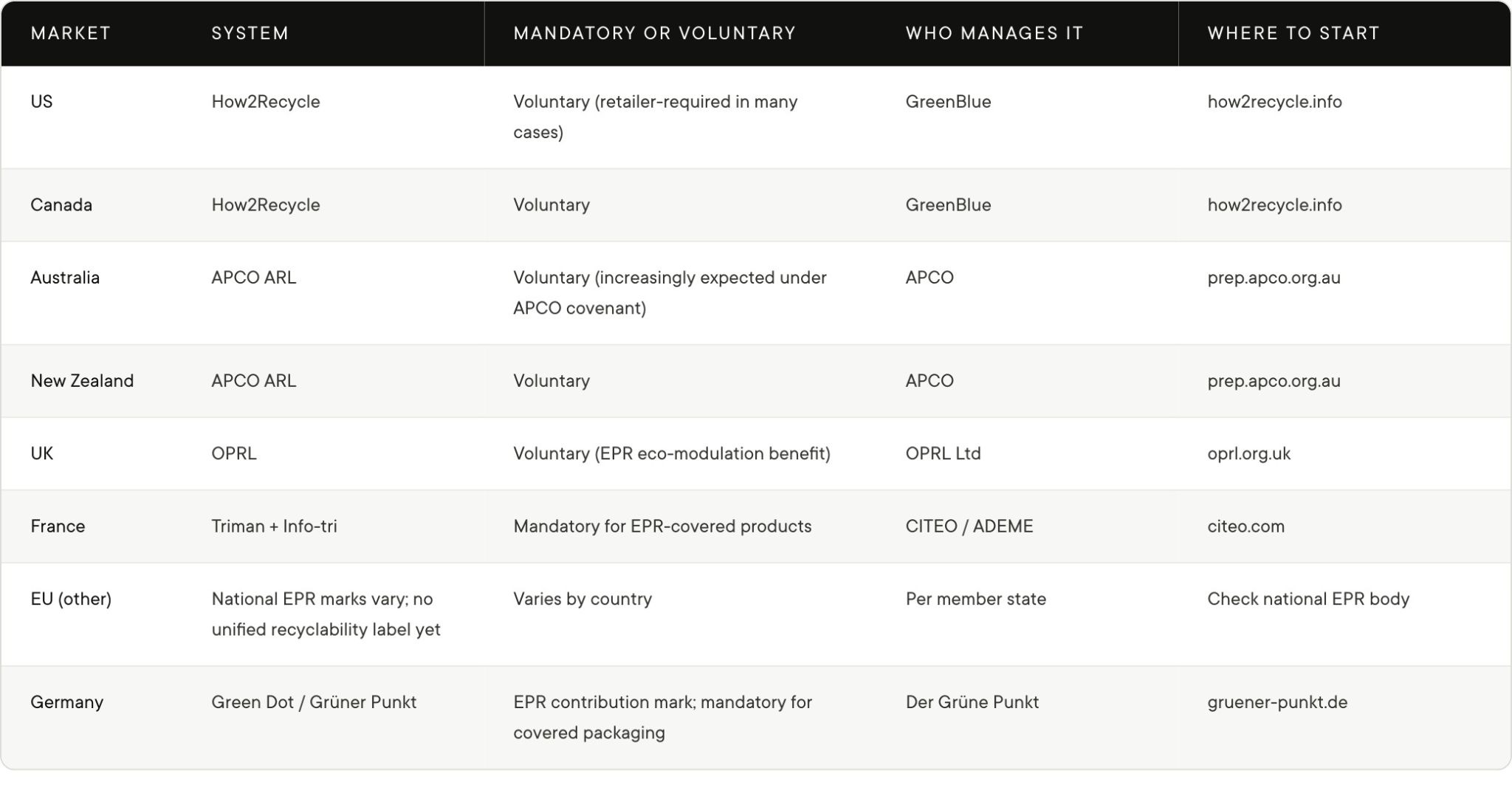
A note on the EU: the PPWR, which entered into force in February 2025 with binding obligations from August 2026, is developing a harmonised recyclability labelling framework tied to PPWR recyclability grades (A through D). A single EU recyclability label is likely to emerge from this process. Until it is formally adopted, brands selling across multiple EU member states face a patchwork of national EPR contribution marks rather than a unified recyclability label.
What this means for you and your brand
Getting recyclability labelling right is one of the most direct actions a brand can take to substantiate its sustainability claims, reduce EPR fee liability, and build consumer trust simultaneously. The four main systems covered in this guide — How2Recycle, ARL, OPRL, and Triman — are all accessible, and three of them are achievable without prohibitive cost or process complexity. The PREP assessment for Australia is free for APCO members. How2Recycle and OPRL operate on tiered licensing fees that scale with business size.
Grounded can help you map your packaging portfolio against the relevant labelling requirements for your markets. If you are assessing packaging recyclability for the first time, working through a format transition, or building out your sustainability claims ahead of a regulatory deadline, get in touch with our team.
Frequently asked questions
Is How2Recycle mandatory in the US?
No. How2Recycle is a voluntary programme. However, several major US retailers — including Walmart, Target, and Amazon — require or strongly prefer How2Recycle labelling as part of their own packaging sustainability standards. For brands selling through these channels, it is effectively a commercial requirement even if it is not legally mandatory. Under US state EPR programmes, particularly Oregon and California, How2Recycle assessment methodology is referenced as evidence of recyclability classification.
Can I use the same recycling label across multiple markets?
No. Each system is market-specific and reflects the collection infrastructure in that market. A format that qualifies as "Widely Recyclable" under How2Recycle in the US may receive a "Conditionally Recyclable" designation in Australia, where soft plastic collection infrastructure operates differently. Using a label from one market in another without a separate assessment for that market creates both inaccuracy and greenwashing risk. Brands selling into the US, Australia, and the UK need a separate assessment and licence for each market.
What is the difference between a recyclability label and a recycled content label?
A recyclability label (How2Recycle, ARL, OPRL) communicates what happens to the packaging after use — whether it can be collected and processed through existing recycling infrastructure. A recycled content label or standard (GRS, PCR content percentage) communicates what went into the packaging during manufacturing — the proportion of recycled material used. Both matter, but they are different claims addressing different parts of the lifecycle. A packaging format can contain 100% post-consumer recycled content and still not be recyclable. It can also be widely recyclable while containing no recycled content at all.
Can I put a recyclability label on packaging that goes to store drop-off rather than kerbside?
Yes, in most systems. How2Recycle has a specific "Store Drop-Off" label designed for formats that are recyclable through retail collection points rather than kerbside. The APCO ARL "Conditionally Recyclable" tier covers formats that require drop-off rather than kerbside collection, provided the consumer instruction specifying where to drop it off is included on-pack. OPRL's "Check Locally" label covers formats with variable collection infrastructure, which may include some drop-off schemes. Each system requires that the consumer instruction accurately reflects the actual disposal route available to the majority of consumers in that market.
Other posts you may like:
thumbnail.png)

Explore custom packaging solutions
Subscribe to our newsletter
Stay up to date with packaging news and industry updates.


.webp)