



.png)
May 5, 2026
EU Packaging and Packaging Waste Regulation (PPWR): What Brands Need to Know Today
The EU's Packaging and Packaging Waste Regulation (PPWR) is shaping up to be the most significant overhaul of European packaging law in decades. For brands using flexible and complex laminate packaging, the regulation is not a threat to your format category. It is just a framework that rewards better and thoughtful design. This guide explains everything you need to know, and what you need to do now to leverage this law as an opportunity for your packaging.
What is the PPWR and where did it come from?
The Packaging and Packaging Waste Regulation (PPWR), Regulation (EU) 2025/40, was adopted on 19 December 2024 and published in the EU Official Journal on 22 January 2025. It replaces the Packaging and Packaging Waste Directive (PPWD), which had governed EU packaging law since 1994.
The PPWR sits within the EU Green Deal's Circular Economy Action Plan. Its primary aims are to:
- Reduce unnecessary packaging waste at source
- Make all packaging recyclable in an economically viable way
- Grow the market for post-consumer recycled materials
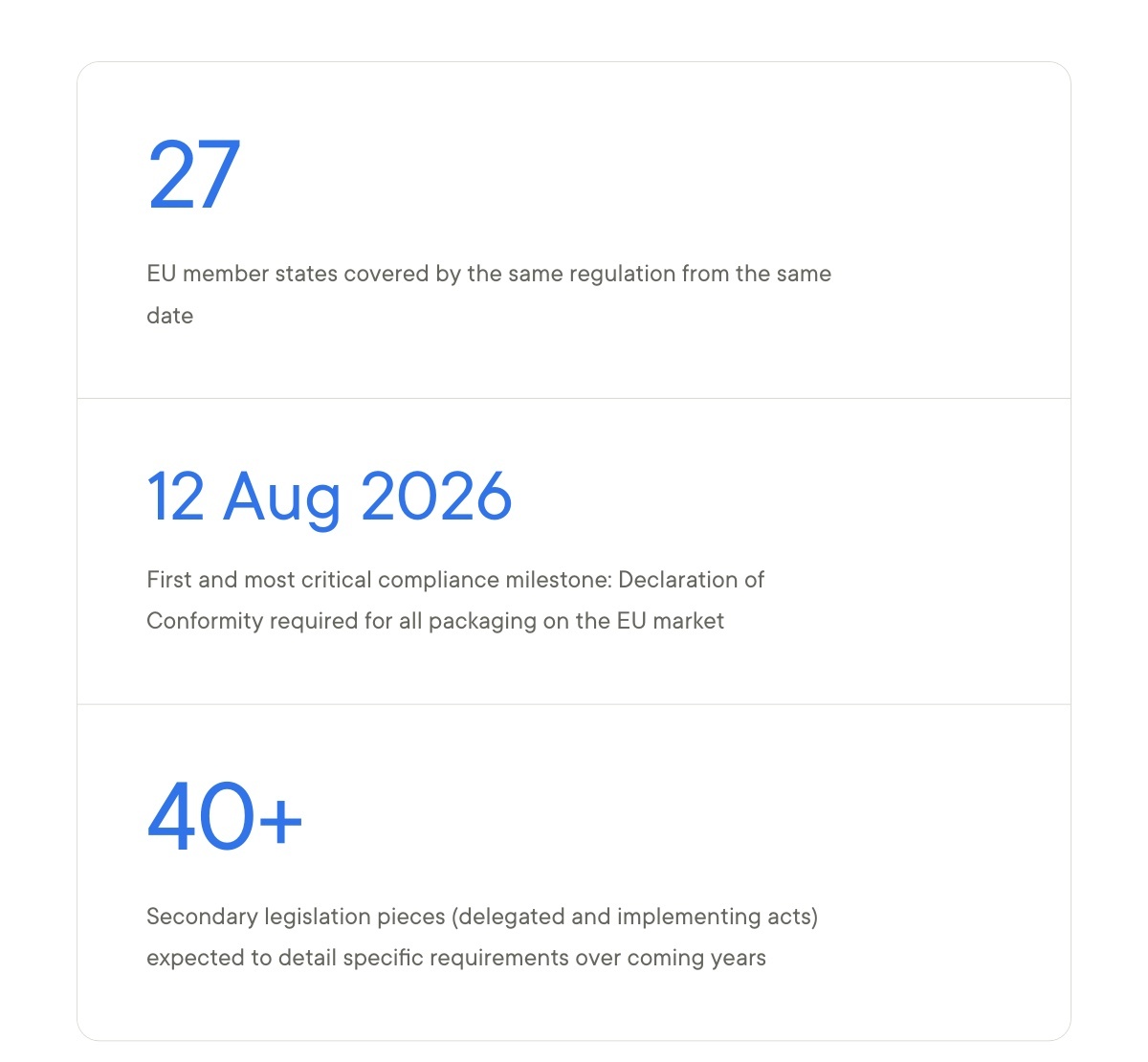
The transition from a directive to a regulation is the structural change that matters most: the old directive was implemented differently by each of the 27 member states, creating a patchwork of national rules. The PPWR is directly applicable everywhere, from the same date, with the same requirements. One regulation, one compliance standard across the EU.
Why this matters more than previous packaging laws: The PPWR places compliance obligations directly on brands and manufacturers. Every packaging format your business places on the EU market will need documented evidence of compliance before it can be sold. This is a fundamental shift in how EU packaging law has historically worked.
Who does the PPWR apply to?
The PPWR applies to all businesses that place packaging on the EU market, regardless of where they are headquartered. Brands based in Australia, the UK, the US, or anywhere else that sell packaged goods into the EU are within scope. The regulation defines two primary obligations roles:
The manufacturer
The manufacturer is the entity that places packaged goods on the EU market for the first time. This is typically the brand owner or importer. The manufacturer must ensure packaging complies with PPWR design and labelling requirements, and must complete a Conformity Assessment and produce a Declaration of Conformity (DoC) before any packaging reaches the EU market. There is only one manufacturer per SKU across the entire EU. Packaging suppliers who produce flexible pouches or laminates on behalf of brand owners must provide technical data to support the DoC, but the compliance obligation rests with the brand owner.
The producer
The producer is the entity that makes packaging available for sale to end consumers in a specific EU member state. This is usually also the brand owner, but may be an importer or retailer. The producer pays EPR fees covering collection and recovery of packaging waste in that member state. There can be multiple producers across the EU, but only one per member state per product.
Declaration of Conformity: your most immediate obligation
The Declaration of Conformity (DoC) is the PPWR's most significant near-term requirement. From 12 August 2026, every packaging SKU placed on the EU market must have a signed DoC before it is made available for the first time. Packaging cannot legally enter the EU market without one.
What is in a Declaration of Conformity
A DoC is a technical document demonstrating, with evidence, that a specific packaging item complies with all applicable PPWR requirements in force at the time it is placed on the market. The manufacturer holds it in internal data management systems and must make it available to national enforcement authorities within 10 days of a request. DoCs must remain accessible with local language translations for five years after placement on the market for single-use packaging, and ten years for reusable packaging.
A valid Declaration of Conformity must include:
- Conformity Assessment evidence: Technical evidence showing compliance with all PPWR requirements in force
- Reference to harmonised standards: Specific standards used to demonstrate compliance, once published
- Packaging description and identification: Detailed description including materials, format, and identifiers such as batch or serial number
- Manufacturer contact information: Details for the manufacturer responsible for the DoC
- Cross-regulation references: Other regulations the packaging conforms to, such as food contact material regulations
DoCs must be kept up to date
A DoC is not a one-time document. It must be updated whenever the packaging changes: new compliance standards come into force, recycled content percentages change, or the format is modified. Importers and authorised representatives must retain a valid DoC when importing into the EU.
The data challenge for flexible packaging brands
For flexible packaging and complex laminate structures, completing a DoC requires technical data that spans multiple layers of your supply chain. Material composition by layer, adhesive chemistry, barrier coating chemistry (especially relevant for PFAS), ink and pigment data, and recyclability assessment evidence all need to be consolidated at SKU level. Beginning the data gathering process now is essential: the lead times for obtaining technical documentation from raw material suppliers and converters are significant, and the August 2026 deadline is closer than it appears when mapped against real procurement and development cycles.
PFAS and substances of concern
The PPWR introduces binding limits on per- and polyfluoroalkyl substances (PFAS) in food contact packaging from 12 August 2026. This is one of the most time-sensitive requirements for flexible packaging brands, because many paper-based and some plastic-based flexible formats have historically used fluorinated chemistry for grease and oil resistance.

PFAS limits in food contact packaging
Total fluorine testing is the recommended first step. If total fluorine is below 50 mg/kg, packaging can be assumed compliant. If it exceeds that level, more detailed targeted PFAS analysis is required. Supplier statements are no longer sufficient as evidence; laboratory testing is now a commercial and legal requirement. National enforcement agencies have authority to spot-test packaging for PFAS.
Broader substances of concern
The European Commission and the European Chemicals Agency (ECHA) must publish a complete list of Substances of Concern (SoC) in packaging by end of 2026. A SoC is defined as any element in packaging materials or components that may adversely affect human health, the environment, or the quality of recycled or reused materials. However, the existing heavy metal restriction is maintained: the combined concentration of lead, cadmium, mercury, and hexavalent chromium must not exceed 100 mg/kg in packaging or its components.
Recyclability requirements
The PPWR requires all packaging on the EU market to be recyclable. The detailed criteria for what counts as recyclable, and how different formats will be graded, will be set through delegated acts that the European Commission is developing for adoption by 1 January 2028.
The A to C grading system
Recyclability will be graded A to C using Design for Recycling (DfR) criteria. Packaging that does not achieve grade C will be classified as non-recyclable and prohibited from the EU market from 1 January 2030. Packaging must achieve at least grade B from 1 January 2038. The grading criteria are still being finalised, but they will assess real-world recyclability: whether a format is actually collected, sorted, processed, and converted into secondary material at meaningful scale in the EU, not just whether it could theoretically be recycled.
- August 2026: All packaging must be recyclable under existing PPWD definition. DoC not yet required for recyclability specifically until DfR acts come into force.
- January 2028: EC adopts Design for Recycling criteria and A to C recyclability grades through delegated acts
- January 2030: Packaging below grade C is banned from the EU market. All packaging must be Designed for Recycling.
- January 2035: All packaging must be Recycled at Scale: recycling infrastructure must exist at sufficient EU-wide scale
- January 2038: Packaging must achieve at least grade B for EU market access
Designed for recycling versus recycled at scale
- The distinction between these two standards is one of the most important nuances in the regulation. Designed for Recycling (2030) is about packaging design: does the format, in principle, allow recycling to take place?
- Recycled at Scale (2035) is about infrastructure: does actual collection, sorting, and processing capacity exist at meaningful scale in the EU?
These are meaningfully different tests, and the gap between them is where much of the transition challenge for flexible packaging sits. A packaging format can be designed to be recyclable years before the infrastructure to recycle it at scale exists.
What the PPWR means for flexible plastic packaging
The PPWR creates a clear split: some flexible formats are already well-positioned, and some need to change. Understanding that distinction now determines whether the transition is managed proactively or reactively.
Why complex laminates face a recyclability challenge
Multi-layer laminates (the standard structure for coffee, pet food, snacks, and retort pouches) combine different polymer films (typically PET outer, PE inner, sometimes with foil) bonded with adhesive. At materials recovery facilities, optical sorting identifies them as mixed materials and diverts them from single-material recycling streams. Separating the layers post-collection requires specialist technology that does not currently exist at EU kerbside scale.
Under PPWR's Design for Recycling criteria, complex multi-layer laminates are likely to receive a low grade: possibly grade C or below. The criteria are not finalised until January 2028, and the ban on sub-grade-C packaging does not apply until January 2030. The design direction is clear, even if the final grading is not.
Why all-PE mono-material flexible packaging is the viable path forward
All-PE pouches, bags, and films are made from a single polymer family. MRFs can sort them into a single stream, and mechanical recycling technology for flexible PE film is scaling across Europe, with kerbside collection already operational in several member states.
For brands, this creates two compounding advantages:
- DfR grade: A mono-material flexible pouch can achieve a strong Design for Recycling grade, keeping it market-accessible post-2030.
- EPR fee savings: Under PPWR's eco-modulated EPR system (anticipated from 2029), recyclable formats pay lower fees across all EU member states. Brands that transition before fees activate lock in a structural cost advantage that compounds annually.
For most snack, pet food, and dry goods applications, all-PE structures are already commercially viable.
The 2035 recycled at scale requirement
A strong DfR grade in 2030 does not automatically satisfy the 2035 Recycled at Scale standard, which requires collection, sorting, and processing infrastructure to exist at meaningful EU-wide volumes, not just in principle. For flexible PE film, this infrastructure is developing. Germany, the Netherlands, Belgium, and Scandinavia are leading investment. PPWR accelerates this by making non-recyclable formats progressively more expensive through eco-modulated fees, driving both brand behaviour and infrastructure build simultaneously.
What flexible packaging brands have working in their favour
- Material efficiency: Flexible packaging uses significantly less material per unit than rigid alternatives, an inherent advantage under PPWR's minimisation requirements that reduces EPR fee exposure.
- Food contact exemptions: Flexible packaging in food or feed contact applications is explicitly exempt from PPWR's transport reuse targets, protecting the dominant use case for most flexible brands.
- Lead time advantage: Brands designing toward mono-material recyclable structures now have two years before the DfR criteria are published in 2028. Enough time to validate structures and supplier relationships before the 2030 deadline applies.
- Cost trajectory: Early transition to recyclable mono-material formats generates lower eco-modulated EPR fees from 2029 across every EU market. The economics favour moving early.
Recycled content targets
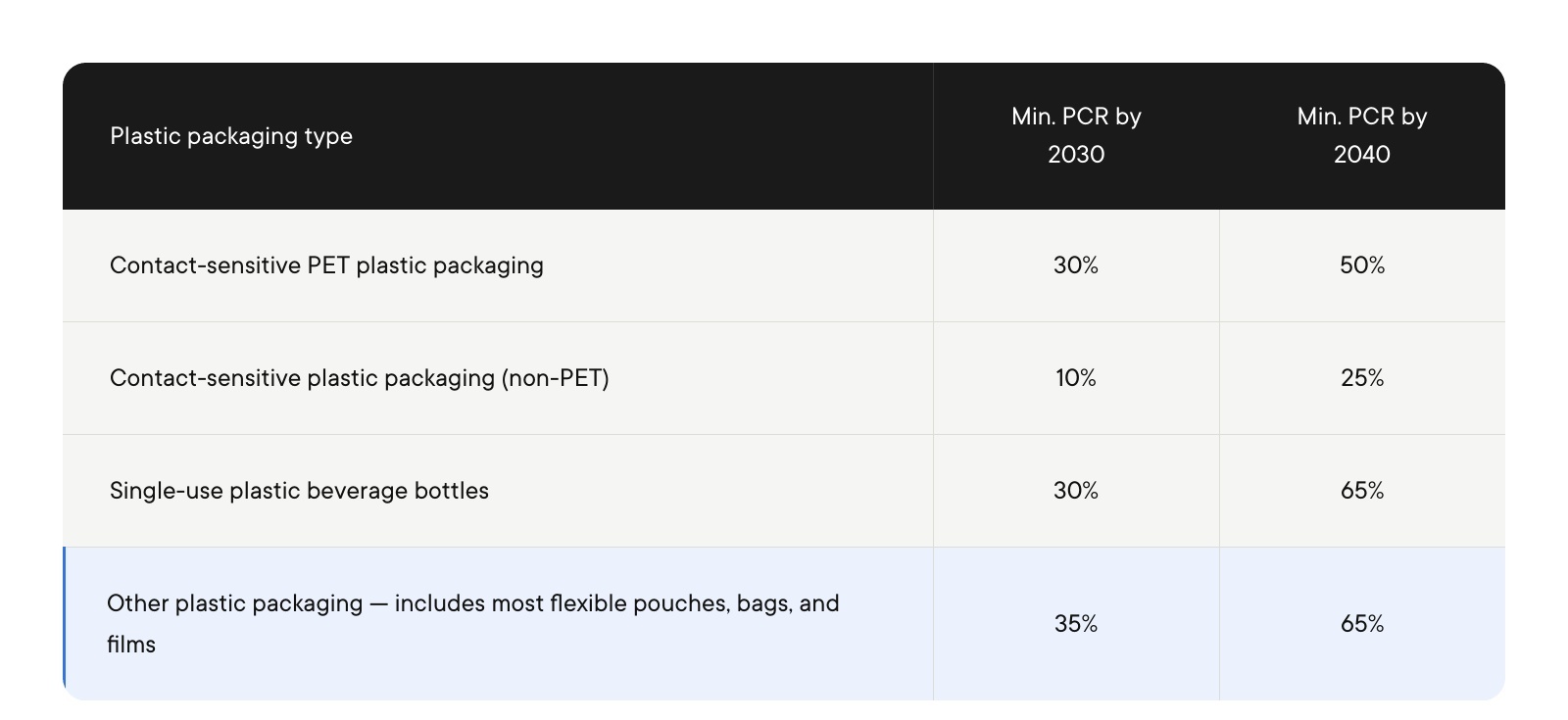
The PPWR introduces mandatory minimum post-consumer recycled (PCR) content targets for plastic packaging, from 1 January 2030.
Packaging minimisation and format restrictions
From 1 January 2030, all packaging must be scaled down to the minimum size, weight, volume, and number of layers necessary to ensure product safety and functionality. Packaging that creates a misleading impression of greater product volume through double walls, false bottoms, or unnecessary layers will be banned. For transport and e-commerce packaging, the permitted empty space ratio will be capped at 50%.
Format bans from 2030
The following packaging formats are prohibited from the EU market from 1 January 2030:
- Single-use plastic grouped packaging (collation films, shrink wrap)
- Single-use plastic packaging for fresh fruit and vegetables under 1.5 kg
- Expanded Polystyrene in retail food packaging
- Single-use plastic packaging for food and drink in hotels/restaurants/cafes
- Single-use plastic condiment, sauce, and seasoning sachets in hotels/restaurants/cafes
- Single-use hotel miniature packaging
- Very lightweight plastic carrier bags under 15 micron
Reuse and refill targets
The PPWR also sets aspirational reuse targets across several packaging categories.

Harmonised labelling
The PPWR will replace fragmented national labelling schemes (such as France's Triman logo and Italy's disposal codes) with a single EU-wide system. The harmonised system will be accompanied by a QR code linking to additional sorting information.
Timeline for labelling requirements
- 12 August 2026: Implementing acts defining the harmonised label design scheduled for adoption
- 2027: Digital identifiers (QR codes) with environmental information required on packaging
- 12 August 2028: Harmonised pictogram labels mandatory on new packaging (two-year transition from August 2026). Further three-year window to use up existing stock placed on market before August 2028.
EPR and eco-modulated fees under the PPWR
Extended Producer Responsibility existed under the old packaging directive but was implemented inconsistently across member states. The PPWR mandates harmonised, eco-modulated EPR fees in every EU member state, based on packaging recyclability grades and recycled content. This is one of the most commercially significant aspects of the regulation for flexible packaging brands.
How eco-modulation works
Under eco-modulation, packaging with higher recyclability grades (A and B) pays lower EPR fees. Packaging with lower grades (C or below) pays higher fees. PCR content above defined thresholds provides additional fee reductions. This creates a direct, ongoing financial incentive for brands to improve packaging sustainability, because better packaging means lower costs every year in every EU market.
The anticipated timeline for implementing eco-modulated fees based on PPWR recyclability grades is from approximately 2029, once the Design for Recycling criteria are finalised and the grading system is in place. For flexible packaging brands, the fee differential between a recyclable mono-material pouch and a non-recyclable multi-layer laminate will be meaningful and ongoing from that point.
EPR registration
By 2027, producers must register with EPR systems in each EU member state where they sell packaging. From 2029, national packaging databases are expected to be consolidated into a single EU-level producer registry, potentially simplifying compliance for brands managing EPR across multiple markets.
Full PPWR timeline: 2025 to 2040

What flexible packaging brands should do now
The August 2026 deadline is the immediate priority. The actions below are in order of urgency.
1. Test for PFAS immediately
If your flexible packaging uses fluorinated barrier coatings or grease-resistant treatments in food contact applications, commission total fluorine testing now. This is the most time-sensitive technical compliance action because the August 2026 deadline is hard and non-compliant food contact packaging cannot enter the EU market. Fluorine-free alternatives are available; the time required is to test, validate, and transition supply, not to find a solution.
2. Build your DoC data infrastructure
Map every flexible packaging SKU you sell in the EU. For each one, identify the data you need: material composition by layer, adhesive chemistry, barrier coating specifications, ink and pigment data, supplier documentation, and any recyclability assessment evidence. Assign ownership in your organisation and begin engaging your packaging suppliers formally for technical data. The data collection process for a complex laminate portfolio takes longer than most brands expect.
3. Assess your laminate and multi-layer portfolio against the 2030 timeline
Review every multi-layer laminate structure you use against the likely DfR grading direction. Structures that combine incompatible polymer families with adhesive bonding, or that include foil layers or metallisation that disrupts optical sorting, are the highest-risk formats for sub-grade-C classification. Prioritise these for redesign evaluation. Reach out to our team to discuss recyclable packaging solutions now.
4. Engage your supplier on PCR content roadmaps
The 35% PCR target for most flexible plastic packaging by 2030 requires planning now. Speak to our team now about incorporating post-consumer recycled content into your packaging.
5. Register with EU EPR systems
If you sell packaged goods in EU member states and are not yet registered with local EPR systems, begin that process. By 2027, registration is required in every member state where you place packaging on the market. Many member states already have registration requirements under existing legislation that applies now.
Compounding opportunity in the transition: Brands that use PPWR as the impetus to transition to mono-material recyclable flexible structures before 2029 will compound the benefit:
- Lower eco-modulated EPR fees from 2029
- No market access risk from the 2030 format restrictions
- A packaging portfolio that is genuinely more sustainable and more aligned with where retailers, consumers, and regulators are heading
Grounded's perspective
PPWR is the most significant structural shift in EU packaging in a generation. For brands willing to act ahead of the deadlines, it is also a commercial lever. Compliant packaging attracts lower EPR fees, reduces exposure to penalty risk, and meets the procurement criteria that European retailers are increasingly applying to their supplier lists. Getting your formats right now means you are not absorbing the cost of a forced redesign in 2029 or 2030 under time pressure.
Grounded works with packaging buyers, brand owners and sustainability teams to navigate exactly this: translating regulatory requirements into a practical packaging roadmap, with honest assessment of the trade-offs involved. If you want to understand where your current formats sit against the PPWR framework and what your options are, get in touch with our team.
Reach out to our team to discuss EU packaging solutions now.
Frequently asked questions
Does the PPWR apply to my brand if we are based outside the EU?
Yes. The PPWR applies to all businesses that place packaging on the EU market, regardless of where they are headquartered. If your brand sells packaged goods in the EU, whether directly, through a distributor, or via e-commerce, you are in scope. Importers into the EU typically take on the manufacturer's obligations, meaning your EU importer may require technical documentation and DoC support from you as part of their own compliance requirements.
Is all-PE flexible packaging recyclable under the PPWR?
All-PE mono-material flexible packaging is the format best positioned for a strong Design for Recycling grade, because it is sortable by NIR optical equipment at MRFs and processable by mechanical film recycling technology. However, achieving a Designed for Recycling grade also depends on the specific structure including adhesives, inks, and any functional coatings, not just the polymer type. And achieving Recycled at Scale by 2035 depends on infrastructure availability across the EU, not just design. All-PE is the right direction, but the complete compliance picture includes PCR content (35% by 2030), DoC documentation, and PFAS-free barrier coatings for food contact formats.
What is the difference between designed for recycling and recycled at scale?
Designed for Recycling (required from 2030) is a design standard: does your packaging, in principle and by structure, enable recycling to take place? Recycled at Scale (required from 2035) is an infrastructure standard: does the actual collection, sorting, and processing capacity to recycle your packaging exist at meaningful volumes across the EU? A packaging format can be Designed for Recycling well before the infrastructure to recycle it at scale exists. For flexible film specifically, infrastructure development across the EU between now and 2035 is a critical factor in whether even well-designed mono-material structures will meet the 2035 standard.
What is a Declaration of Conformity and when do I need one?
A Declaration of Conformity is a technical document demonstrating that a specific packaging SKU complies with all applicable PPWR requirements. It must be in place for all packaging placed on the EU market from 12 August 2026. For flexible packaging brands, the DoC typically requires material composition data by layer, substances of concern evidence, PFAS test results for food contact formats, and recyclability assessment documentation. Packaging cannot legally be placed on the EU market without a valid DoC.
Sources and further reading
- Regulation (EU) 2025/40, European Parliament and Council, 19 December 2024: eur-lex.europa.eu
- European Commission PPWR overview and FAQ, March 2026: environment.ec.europa.eu
- EUR-Lex PPWR summary: eur-lex.europa.eu
- PPWR key requirements from August 2026 (Gleiss Lutz): gleisslutz.com
- PPWR highlights and compliance challenges (Keller and Heckman): khlaw.com
- PPWR compliance and recycled content guide (Circularise, 2025): circularise.com
- PPWR and e-commerce obligations (Greenberg Traurig, 2025): gtlaw.com
- Anthesis PPWR white paper (2026 edition): anthesisgroup.com
- UK government PPWR guidance for exporters: business.gov.uk
Other posts you may like:
thumbnail.png)

Explore custom packaging solutions
Subscribe to our newsletter
Stay up to date with packaging news and industry updates.


.webp)