Close Cookie Popup
Cookie Settings
By clicking “Accept”, you agree to the storing of cookies on your device to improve our services and your browsing experience.
.svg)
Grounded Packaging
×
Ozone Coffee
A B Corp roaster reversed course on compostables, switched to a single mono-material PCR pouch, and used packaging as a margin lever during the worst coffee-price crisis in decades.
Ozone Coffee is one of the most respected speciality roasters in the UK and New Zealand, known for their long-term commitment to sustainability, community impact, and responsible sourcing. A certified B Corp since 2022 and winner of Most Sustainable Brand at the European Coffee Awards (2024), Ozone approaches every part of its business, from farming partners to packaging, with a systems-thinking approach.
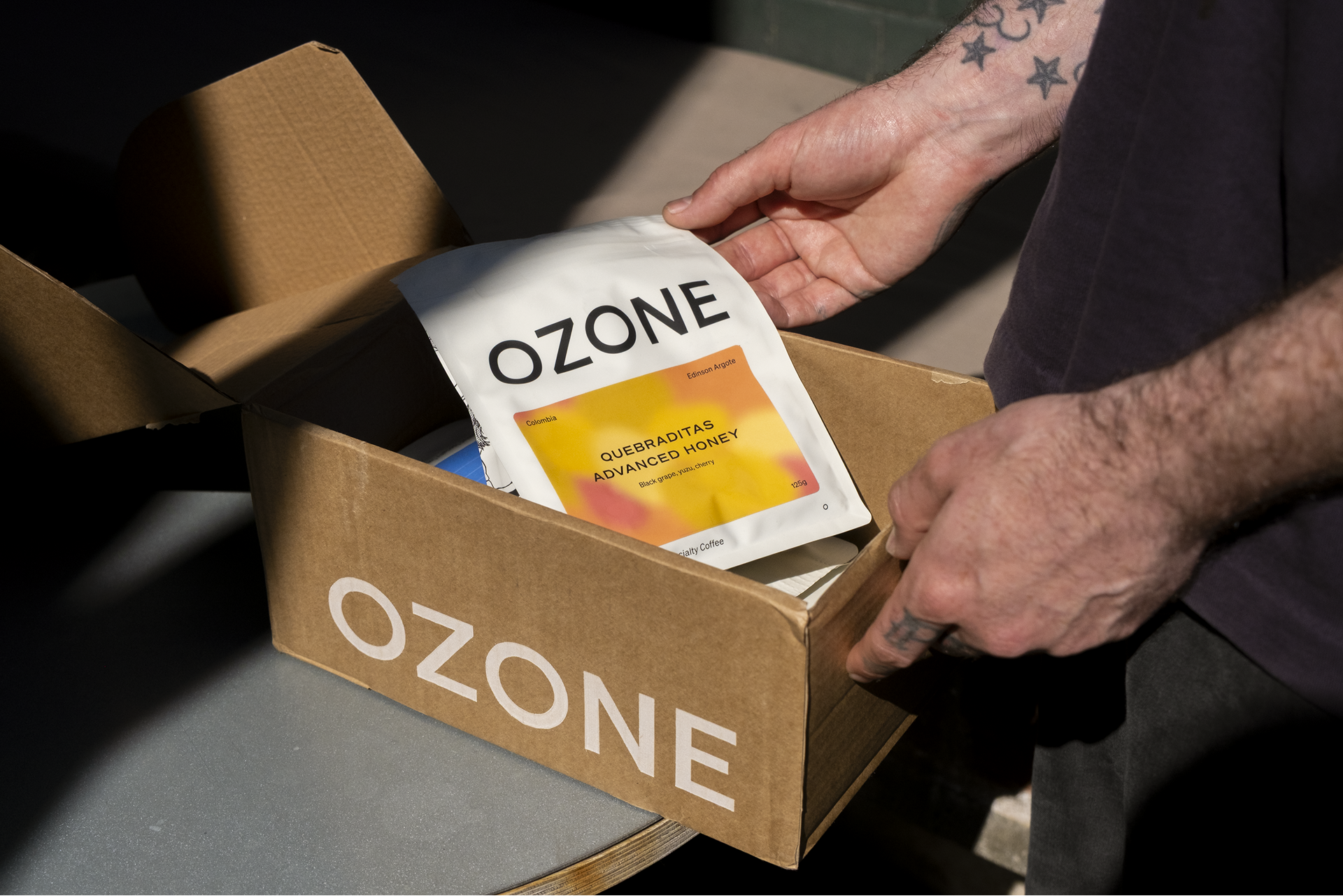
Grounded first partnered with Ozone in 2022. Since then, we've supported the brand across several phases of their packaging evolution, helping them shift from virgin plastic to compostable films in 2022 and now into high-performance mono-material flat-bottom pouches made from up to 70% post-consumer recycled (PCR) content.
The result: a packaging system that is more sustainable, reduces cost, and is better suited to the realities of their retail, wholesale, and subscription channels.
Scope LCA, ISO 14040 cradle-to-gate, Q4 2025
Royal Mail large letter optimisation, 12-month rollout
Retail, wholesale, ecom, subscription
Moving to recyclable PCR pouches saved >6,000 kg CO₂ per 100,000 pouches for Ozone Coffee. The annual CO₂ absorption of 313 trees, per 100,000 pouches.
Across 100,000 units that's 509 kg of material avoided every year. Less material = lower freight, lower per-unit cost, smaller footprint.
In 2022, Ozone Coffee championed compostable packaging as they transitioned away from virgin PE. By 2024, they were back to the drawing board.
The reason was simple. Most UK and New Zealand households can't access industrial composting. Bags labelled "compostable" were ending up in landfill, which is the exact outcome the switch from virgin PE was meant to avoid. And the barrier performance of compostable films couldn't match what specialty coffee needs to protect flavour over a shelf life.
The timing made the decision urgent rather than optional. Between October 2023 and November 2025, ICO Composite green coffee prices rose more than 115%, peaking at 330.44 US cents/lb, the highest sustained levels in decades. Freight stayed elevated post-pandemic. UK postal rates climbed. With the cost of green coffee outside their control, Ozone needed every other line in the operation to work harder. Packaging was one of the bigger levers available.
Ozone's previous system ran two formats across two channels: a premium flat-bottom pouch for retail, and a lightweight stand-up pouch for the In My Mug subscription. Across some blend ranges that's 25+ coffee SKUs, doubled in the roastery.
The brief for the new system was specific:
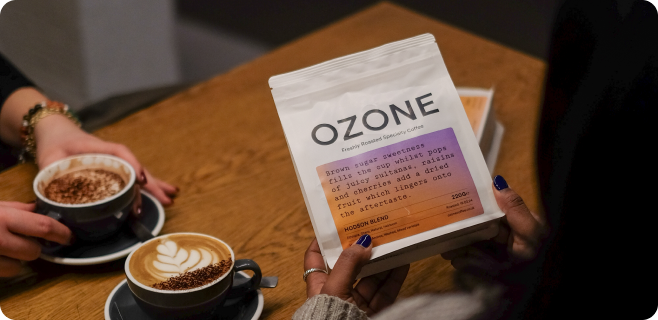
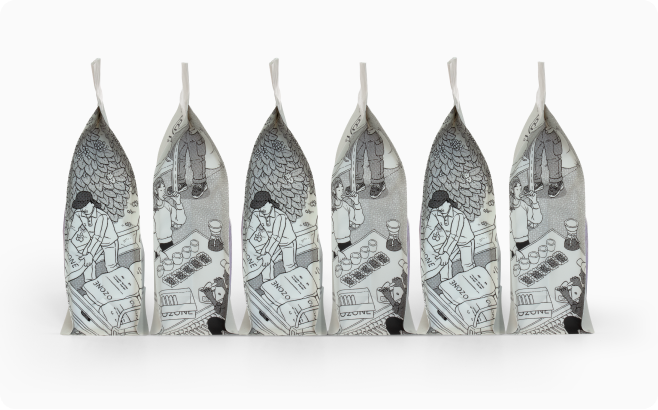
Grounded developed a single dual-purpose flat-bottom pouch in mono-material PCR (up to 70% post-consumer recycled food-safe LDPE). It's engineered to stand on a shelf with the presence Ozone's wholesale customers expect, and to flatten into a letterbox-compliant format when filled at subscription weights.
It's recyclable through soft-plastic collection schemes that already exist: Tesco, Sainsbury's and Co-op front-of-store points in the UK, and the 200+ drop-off points in the NZ Soft Plastics Recycling Scheme.
The second piece was operational. Grounded's drawdown inventory model, already running for Ozone NZ, is now rolling out in the UK. Ozone draws stock as it's needed and is invoiced monthly based on how much is used, instead of paying for full inventory upfront.
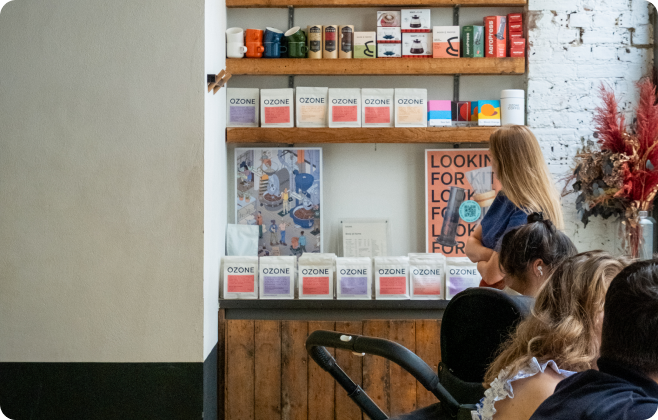
70% post-consumer recycled content. 59% carbon reduction versus the previous compostable packaging, verified through comparative LCA. Designed for genuine recyclability through existing soft-plastic collection in both markets, with the UK government's March 2027 mandate for kerbside soft-plastic collection set to extend that to home recycling.
59% reduction in subscription postage costs through Royal Mail large letter optimisation. Two SKUs collapsed into one across every channel. Lower per-unit packaging cost through consolidated volume. Reduced product wastage from the better barrier. Working capital freed up through the drawdown model. Zero postal-system pushback over 12 months in market.
Letterbox-compatible delivery for the entire In My Mug subscription base. As Alex put it: "There's nothing worse than getting home and you've missed your coffee delivery because it couldn't fit in the letterbox." The print quality of the PCR material has also opened doors with white-label partners including Ottolenghi and Federal, where shelf finish is non-negotiable.
The transition coincided with Ozone's B Corp recertification, with the new packaging system feeding directly into their improved impact score. Communicating the reversal to customers was the harder part of the project. Ozone wrote a public explanation rather than quietly switching, and the response was overwhelmingly positive.
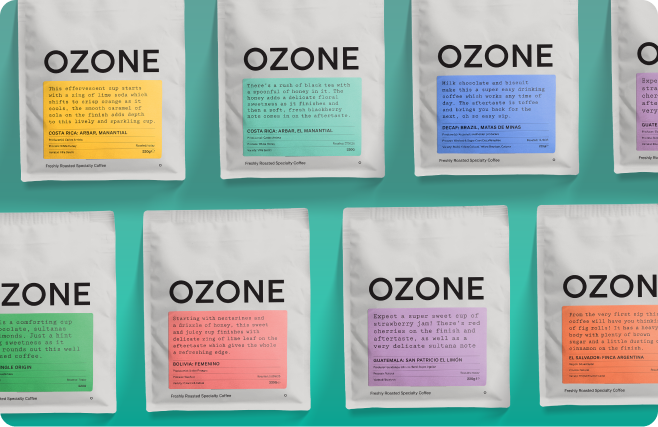
Ozone's packaging evolution shows what happens when sustainability decisions are made against the infrastructure that exists rather than the one that should exist. Compostables made sense on paper. PCR mono-material made sense in practice. The cost win and the carbon win came from the same decision.
For specialty roasters managing the same green-coffee crisis, and for premium food brands more broadly, packaging is one of the few line items where a single change can do four jobs at once: cut cost, improve product, simplify operations, and reduce real-world impact.
By converting from compostable to post-consumer recycled material, Ozone Coffee has:
To put that into perspective, that carbon emission reduction equates to approximately 22 LA–NY flights' worth of emissions avoided per year.
Due to the soft plastic recycling streams available in the UK market, this material change means >300kg of packaging is diverted from landfill per year.
Ozone Coffee's packaging is certified food safe and produced in Sedex-certified supply chains.
By partnering with Grounded Packaging, Ozone Coffee's packaging has contributed to kelp and mangrove restoration projects across Indonesia, Cambodia, Palos Verdes, and Southern California.
Scope generates lifecycle data for any flexible packaging format.


.webp)