





.png)
April 1, 2026
UK EPR vs EU PPWR from 2026: A Practical Compliance Guide for Flexible Packaging Brands
From 2026 onwards, packaging compliance in the UK and Europe stops being a future problem and becomes a live operational issue for brands, particularly those using flexible packaging. Two regulatory regimes are driving this shift.
In the United Kingdom, Extended Producer Responsibility (EPR) is moving from theory to cash, with confirmed fees, growing eco-modulation, and increasing pressure from finance teams on packaging decisions.
In the European Union, the Packaging and Packaging Waste Regulation (PPWR) introduces a single EU-wide framework combining design rules, market-access requirements, and EPR obligations under one umbrella
These systems are related but not interchangeable. Understanding the nuance of each is critical for any brand operating in the region.
Start with the right mental model
The UK and EU are solving similar problems in different ways. Both regimes aim to shift waste costs back to producers, improve recyclability and real-world outcomes, and force better packaging data and governance. But they do it through very different levers.
The EU model: PPWR as the umbrella, EPR inside it
In the EU, PPWR is the top-level rulebook. It sets what packaging is permitted to be placed on the EU market, defines recyclability, labelling, minimisation, reuse, and recycled-content requirements, and embeds EPR as the funding mechanism for waste management once packaging has passed those design tests. Packaging must first pass PPWR design requirements. Only then does EPR apply. Paying higher EPR fees does not make non-compliant packaging compliant.
The UK model: EPR as the primary compliance mechanism
The UK does not have a PPWR-equivalent market-access regulation. UK packaging compliance is driven through EPR registration, detailed data reporting, and fees increasingly modulated by recyclability. In the UK, most packaging can still be sold but some formats will cost materially more to put on the market. This distinction is the most important thing to understand before making packaging decisions for either market.
UK EPR from 2026: what brands actually need to do
Who is obligated
Under UK EPR, a “producer” may be the brand owner, the importer, the packer/filler, or the seller of packaged goods into the UK market. For most mid-to-large brands: mandatory registration, full data reporting, and liability for waste-management fees.
You must comply with UK EPR packaging rules if both apply:

Large vs small producer thresholds
Large producer: Turnover ≥2m AND >50 tonnes packaging handled. Reports twice yearly. Pays EPR waste management fees.
Small producer: £1m-£2m AND >25t, OR >£1m AND 25-50t. Reports annually. Not currently paying EPR fees (under review).
Note: corporate group thresholds apply at group level.
What data you must collect and report
UK EPR reporting requires granular packaging data: material type, format, weight, and whether packaging is household or non-household. For flexible packaging, common problem areas include:
- Multi-layer structures reported as a single material
- Coatings, adhesives, valves, zips, and liners omitted
- Paper-plastic composites misclassified
- Inconsistent assumptions around household classification for e-commerce
From 2026 onwards, poor data creates direct financial exposure through incorrect fee calculation, audit vulnerability, and inability to defend packaging decisions under regulatory scrutiny.
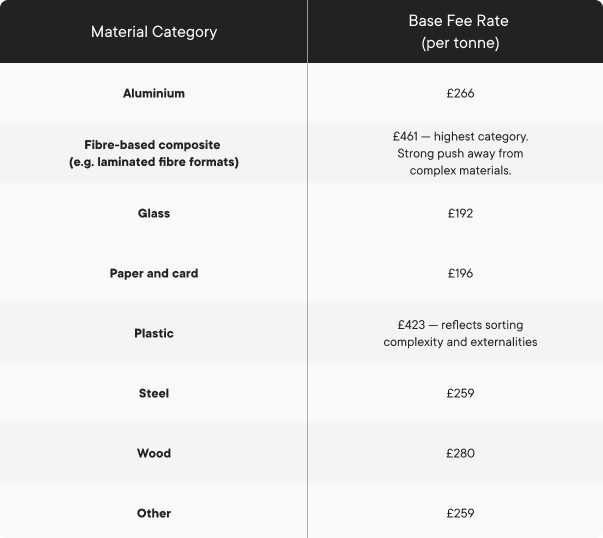
UK EPR base fees (2025 and 2026, per tonne)
Invoicing and cash flow
First invoices: October 2025 (large producers), calculated from 2024 calendar year volumes.
Payment options: 50 days, or quarterly instalments (Nov 2025, Jan 2026, Apr 2026, Jun 2026 at 25% each).
Warning: an October 2025 invoice can feel like a sudden hit if liability was not accrued as volumes were sold.
The double system: EPR fees AND PRNs still apply
EPR fees fund local authority waste management. PRNs remain the mechanism for meeting recycling targets. Large producers must still buy PRNs and PERNs. PRN pricing is volatile, especially plastics. Your total compliance cost exposure can swing due to PRN market dynamics even with robust EPR fee modelling.
2026 is the real step change: eco-modulation via RAM
From 2026, UK EPR links cost to recyclability through modulated fees. Packaging is rated via the Recyclability Assessment Methodology (RAM):
- Green: widely collected and recyclable
- Amber: recyclable with limitations
- Red: difficult to recycle or incompatible with UK infrastructure
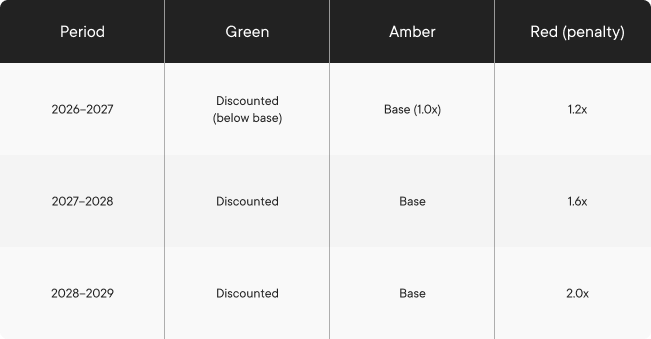
Example (plastic): Base fee £423/tonne. Red 2026 at 1.2x = £507.60. Red 2028 at 2.0x = £846.
High-risk Red triggers brands miss
For plastics:
- Small components rule: rigid plastic components under 40mm in two dimensions tend to be Red — they fall through MRF screens
- Carbon black pigments: often invisible to NIR sortation
- PVC and PS: typically downgraded due to limited infrastructure
- Complex laminates: multi-polymer structures that cannot be separated
- Compostables and bioplastics: generally Red due to contamination risk
For paper and board:
- Double-sided lamination and excessive foil or glitter can trigger Red (foil threshold: 15% non-paper content by weight)
For glass:
- Sleeves or labels covering more than 60% of the container can cause sortation misidentification
EU from 2026: PPWR + EPR working together
What changes in 2026
The PPWR framework applies from 12 August 2026. This means PPWR becomes the default design baseline for EU packaging, and packaging decisions made in 2026–2027 must anticipate later requirements.

What PPWR adds beyond EPR
For brands using flexible packaging, the most material additions are:
- Recyclability requirements: packaging must be designed for recycling and, over time, must be recyclable in practice and at scale
- Recyclability performance grading: packaging is graded A, B, or C. Grade A attracts lowest EPR fees and faces no restrictions. Grade C attracts penalties and may face market access limitations
- Packaging minimisation rules: excess layers, unnecessary headspace, and over-engineered structures must be actively justified
- Harmonised labelling and sustainability claims: claims such as ‘recyclable’ must be consistent, legally defensible, and aligned with PPWR definition
- Recycled content requirements for plastics: ramp progressively through the late 2020s and into the 2030s

None of these obligations are resolved by paying higher EPR fees. They require packaging design decisions to be correct from the outset.
Technical documentation: the quiet compliance risk
Under PPWR, brands must maintain technical documentation demonstrating compliance. For flexible packaging, this typically includes:
- Full material structures and layer breakdowns
- Inks, adhesives, and coatings declarations
- Recyclability assessments aligned to EU design criteria
- Justification for barrier layers or complex constructions
- Supplier declarations and change-control records
This documentation is what protects brands during audits, enforcement actions, and retailer compliance challenges, all of which are becoming more frequent. Brands that cannot produce it on request face exposure that goes well beyond a fee adjustment.
UK vs EU: where they align, and where they don’t
Where they are similar
- Both require accurate, defensible packaging data
- Both penalise poorly recyclable flexible formats
- Both increase scrutiny on sustainability claims
- Both push brands toward simpler, better-documented packaging structures
Where they fundamentally differ
- EU PPWR is a market-access regime: non-compliant packaging may ultimately not be sellable
- UK EPR is a cost-allocation regime: packaging remains legal but becomes more expensive
- EU forces design decisions earlier; UK forces economic trade-offs harder
For brands in both markets: design to EU PPWR standards, model UK EPR costs separately.
A flexible packaging design playbook for 2026 and beyond
The right decision hierarchy for flexibles
- Product protection first: shelf life, safety, and performance are non-negotiable, but specs must be documented with evidence
- Design for recycling by default: favour mono-material PE or PP structures with PCR content, or high-barrier papers where they meet performance needs
- Minimise complexity: treat every additional layer, coating, or material as requiring active justification
- Prioritise evidence over intent: if a packaging decision cannot be documented, it cannot be defended
Portfolio segmentation
- Category A: Future-proof: mono-material PE or PP with PCR content, or high-barrier papers with credible recycling pathways. Well-positioned across both UK EPR and EU PPWR
- Category B: Manage and transition: barrier laminates genuinely required for performance, with a defined and time-bound roadmap toward simpler formats
- Category C: High-risk and dead-end: complex composite structures with weak recycling pathways and no credible long-term compliance defence under PPWR. Treat as a liability and prioritise for transition
Designing once for both UK and EU
For brands selling into both markets: design to the stricter direction of travel (EU PPWR) while modelling UK EPR costs separately to understand the financial impact of specific format choices. The cost of redesigning at scale under time pressure is consistently higher than the cost of designing correctly now.
Frequently asked questions
What is the difference between UK EPR and EU PPWR?
UK EPR is a cost-allocation mechanism: packaging remains legal to sell but attracts fees based on recyclability performance. EU PPWR is a market-access regulation: packaging must meet design and recyclability requirements before it can legally be placed on the EU market. Poor recyclability under UK EPR costs you money. Non-compliance under EU PPWR can prevent you from selling at all.
When does EU PPWR come into force?
The PPWR framework applies from 12 August 2026. Not all obligations activate immediately, but it becomes the default design baseline from that date.
Does flexible packaging face higher fees under UK EPR?
Generally yes. Multi-layer laminates and formats with weak real-world recycling pathways typically attract higher fees under eco-modulated EPR. Mono-material PE or PP structures with PCR content attract lower fees. Kerbside collection for flexible packaging is planned within the next 12 to 24 months in the UK, which will improve classifications over time.
Can a format compliant with UK EPR also comply with EU PPWR?
Not automatically. A format that is legal and cost-manageable under UK EPR may still fail EU PPWR design or recyclability requirements. Brands in both markets should design to EU PPWR standards and model UK EPR costs separately.
Other posts you may like:
thumbnail.png)


Explore custom packaging solutions
Subscribe to our newsletter
Stay up to date with packaging news and industry updates.


.webp)