



July 2, 2026
FSC Certification Explained: What It Means for Paper-Based Packaging
Paper packaging is having a moment. As brands shift away from multi material plastic or rigid formats, kraft pouches, paper bags, and fibre-based laminates are appearing across many product categories. Most of them carry an FSC logo. Very few brand teams can explain what that logo actually guarantees.
This guide covers what FSC certification actually certifies, how chain of custody works in practice, the difference between FSC 100%, FSC Mix, and FSC Recycled labels, and what it means specifically for flexible packaging formats.
Quick answer: what is FSC certification on packaging?
FSC (Forest Stewardship Council) certification on packaging means the wood-derived materials in that packaging, such as the paper, kraft, or board, were sourced from forests managed to FSC's responsible forestry standards. Every business in the supply chain between the forest and the finished pack must hold an FSC chain of custody (CoC) certificate for the claim to be valid. FSC certification does not cover recyclability, compostability, or recycled content. Those are separate claims governed by separate standards.
Key facts
- 171 million hectares of FSC-certified forest globally as of end 2025, across more than 80 countries
- 68,000+ FSC chain of custody certificates issued worldwide
- 56% of consumers globally recognise the FSC logo
- FSC chain of custody certification directly supports EUDR compliance for paper and wood pulp packaging materials
- FSC applies to paper and board components only; plastic, foil, and adhesive layers in flexible packaging are not covered
Key definitions
FSC (Forest Stewardship Council): An independent, non-governmental organisation established in 1994 that sets international standards for responsible forest management. FSC certification assures that wood-derived materials in a product come from forests managed to FSC's 10 Principles.
Chain of custody (CoC): The documented, auditable trail that tracks FSC-certified material from the certified forest through every step of processing, conversion, and manufacturing to the finished product. Every business in the chain must hold a valid CoC certificate for the final product to carry FSC claims.
Controlled wood: Wood from uncertified forests that has been screened under FSC's Controlled Wood standard to exclude illegal logging, wood from forests with threatened high conservation values, and other controversial sources. Controlled wood is used in FSC Mix products alongside certified material.
EUDR (EU Deforestation Regulation, Regulation 2023/1115): EU law requiring due diligence documentation for commodities including wood pulp. Large operators became subject from December 30, 2025; SMEs from June 30, 2026. FSC CoC documentation satisfies the traceability requirements.
What is FSC certification and why does it matter for packaging brands?
The Forest Stewardship Council (FSC) is an independent, non-governmental organisation established in 1994. It sets international standards for responsible forest management, and its certification assures that wood-derived materials in products, including the paper, board, and fibre in flexible packaging, come from responsibly managed forests.
FSC matters for packaging brands for two reasons:
- Consumer and retailer expectations. Paper and fibre-based packaging is increasingly expected to carry documented evidence of responsible sourcing. FSC is the most widely recognised standard for this, with 56% global consumer recognition.
- Regulatory requirements. The EUDR requires due diligence documentation for commodities including wood pulp. FSC chain-of-custody certification provides an auditable trail that directly supports compliance.
What FSC does not certify: FSC covers responsible sourcing of wood-derived inputs only. It does not certify recyclability, compostability, or recycled content. A kraft pouch can be FSC certified and simultaneously not recyclable if it has a plastic barrier layer. Both facts are independently true and each requires its own substantiation.
What is FSC chain of custody and how does it work for packaging?
Chain of custody (CoC) certification is the mechanism that makes FSC claims on packaging meaningful and legally valid. Every business in the supply chain between the certified forest and the finished flexible pack must hold a CoC certificate.
The chain works like this:
- A forest is FSC Forest Management certified.
- The wood is processed at a mill holding an FSC CoC certificate.
- The paper goes to a converter also holding an FSC CoC certificate.
- The converter supplies a flexible packaging manufacturer holding an FSC CoC certificate.
- That manufacturer supplies your brand, which either holds its own CoC certificate or operates under a trademark licence from FSC.
If any single entity in this chain does not hold a valid CoC certificate, the claim breaks. You cannot put an FSC logo on your kraft pouch if your packaging converter is not certified, even if the paper mill supplying them is.
How to verify your supplier's FSC certificate
Every FSC CoC certificate holder is assigned a code in the format FSC-CXXXXXX. This code must appear on any product or invoice claiming FSC certification.
- Verify any certificate code at info.fsc.org, FSC's public certificate database.
- Confirm the certificate holder's name, current status (valid, suspended, or terminated), expiry date, and scope.
- A reputable supplier will provide their code proactively. If they cannot, do not place an FSC logo on products sourced from them.
Check that the scope covers packaging conversion. Some FSC CoC certificates cover paper production only, not the conversion of that paper into pouches or bags. Confirm their scope explicitly includes "packaging" before proceeding.
FSC 100%, FSC Mix, and FSC Recycled: what is the difference?
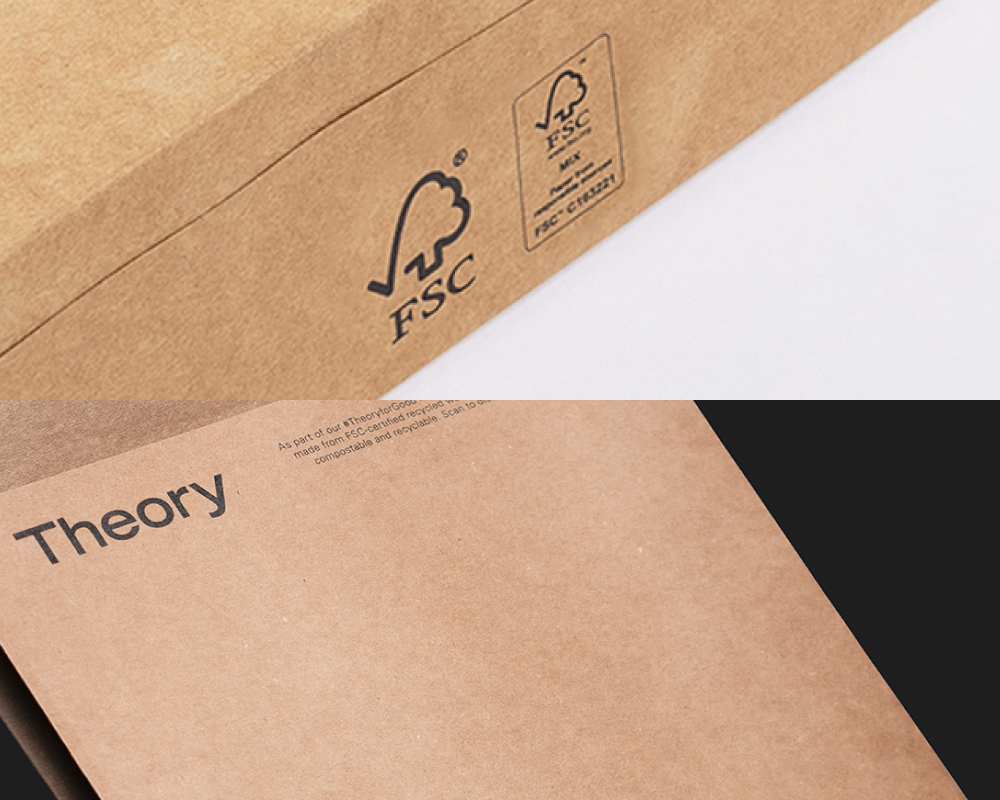
FSC has three distinct label types. Using the wrong label is one of the most common FSC compliance mistakes and constitutes misuse of the FSC mark, which violates licence terms and creates greenwashing exposure.
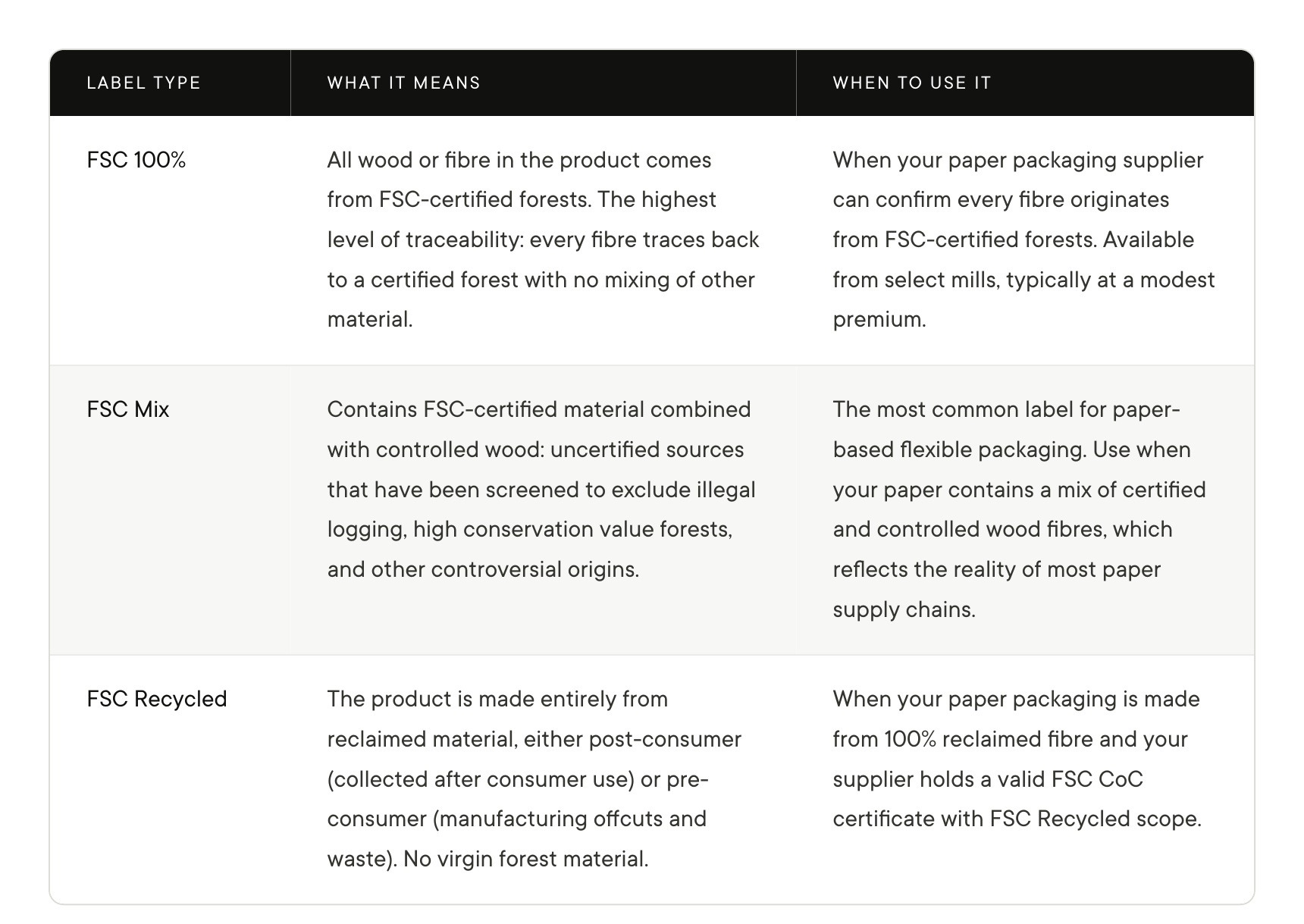
The label must match the material invoice exactly. Placing an FSC Recycled label on FSC Mix material, or vice versa, is a breach of FSC licence terms and can result in suspension of certification. Under FTC Green Guides and EU Green Claims Directive scrutiny, it also creates greenwashing liability.
What is FSC Mix? FSC Mix is a legitimate and widely used certification, not a lesser standard. The Mix label means certified material is combined with controlled wood: wood screened to exclude illegal logging, forests with threatened conservation values, and other controversial sources. FSC Mix reflects the practical reality of most paper supply chains.
What is FSC Recycled? FSC Recycled applies to paper packaging made from 100% reclaimed material, either post-consumer (collected after consumer use) or pre-consumer (manufacturing offcuts and waste). It supports a circular economy approach by reducing demand for virgin forest material.
Which paper-based flexible packaging formats can carry FSC certification?
FSC certification applies to any flexible packaging format where paper or board is a significant structural component.
Kraft paper pouches and bags
Kraft paper is the most common paper-based flexible packaging substrate, used for coffee bags, dry goods pouches, pet food bags, and retail carrier bags.
- FSC Mix is the most commonly available certification for kraft paper, as most mills source from a mix of certified and controlled wood fibres.
- FSC 100% certified kraft paper is available from certain mills and carries a modest premium.
- For brands whose customers or retail partners specify FSC-certified paper packaging, FSC Mix is the practical standard to request.
Paper-based laminates with barrier layers
Many paper-based flexible structures combine a kraft or white paper outer layer with a functional barrier (PE coating, foil layer, or EVOH) for moisture, oxygen, or grease resistance.
- FSC certification in these structures applies to the paper component only.
- Plastic and foil layers are not covered by FSC certification.
- A paper-PE laminate pouch can carry an FSC label based on the paper content, but the claim must not imply the entire structure is FSC certified.
Coated and printed paper packaging
Paper packaging with print, varnish, or surface treatment is eligible for FSC certification, provided:
- The base paper is FSC certified.
- The coating or printing is carried out by an FSC CoC-certified converter.
- Water-based coatings, UV varnishes, and most standard printing inks do not affect FSC eligibility.
FSC vs PEFC vs SFI: which forest certification standard should you specify?
FSC is not the only responsible forest certification standard used in packaging supply chains.
PEFC (Programme for the Endorsement of Forest Certification) is the largest forest certification system in the world by certified area, covering approximately 296 million hectares globally as of September 2025. It is a mutual recognition umbrella scheme that endorses national standards developed at country level. In markets where FSC-certified supply is limited, PEFC is often the practical alternative.
SFI (Sustainable Forestry Initiative) is a North American standard covering approximately 150 million hectares as of 2024, with strong adoption among US-based mills and manufacturers. SFI is endorsed by PEFC. Many US packaging suppliers hold both FSC and SFI certification.
For consumer-facing flexible packaging sold globally, FSC is generally preferred because of its higher consumer recognition, its more demanding social and environmental requirements, and its stronger associations with protecting old-growth and rainforest areas. For B2B and domestic US supply chains, SFI is widely accepted and operationally equivalent to FSC for most purposes.
How to get FSC certification on your packaging
To use the FSC logo on consumer-facing flexible packaging, you need either:
- A trademark licence from FSC directly, or
- To purchase FSC-labelled packaging from a certified supplier who holds the licence (the most common route for brands)
The FSC logo must always appear with:
- The certificate code (FSC-CXXXXXX)
- The correct label type (FSC 100%, FSC Mix, or FSC Recycled)
The logo without a certificate code is misuse of the FSC mark. FSC claims must accurately reflect the source material and must not imply that non-paper components (plastic, foil, adhesive) of a flexible packaging structure are FSC certified.
Promotional licence for off-pack use: Brands that want to reference FSC-certified packaging in marketing materials, websites, or trade presentations without holding a full CoC certificate can apply for a promotional licence from FSC. This permits use of the FSC logo in specific off-pack contexts.
How much does FSC certification cost for packaging? Brands that source FSC-certified packaging from a certified supplier do not pay FSC directly for the certification. The cost is embedded in the material premium charged by the supplier, which varies by paper grade, mill, and volume. Brands that choose to hold their own CoC certificate pay an annual certification body audit fee, typically in the range of a few thousand dollars per year depending on the scope of their operations.
Frequently asked questions
What does FSC certified mean on packaging?
FSC certified on packaging means the paper, kraft, or board material in that packaging was sourced from forests managed according to FSC's international standards for responsible forest stewardship. Every business in the supply chain from the certified forest to the finished pack must hold an FSC chain of custody (CoC) certificate for the claim to be valid. FSC certification does not mean the packaging is recyclable, compostable, or made from recycled content. Those are separate attributes.
Does my packaging supplier need FSC certification or do I?
In most cases, your packaging supplier needs to hold the FSC chain-of-custody certificate, as they are the entity physically handling and converting the certified material. Your brand can then use the FSC logo on the finished packaging without holding its own CoC certificate, by purchasing under your supplier's certificate and obtaining a trademark licence from FSC for promotional use. If your brand imports packaged goods into the EU where EUDR due diligence is required, you may benefit from holding your own documentation. Confirm the appropriate arrangement with your certification body.
My kraft pouch has a PE barrier layer. Can I still use the FSC Recycled label?
You can use the FSC Recycled label if and only if the paper component is made from 100% reclaimed fibre and your supplier holds a valid FSC CoC certificate with FSC Recycled scope. The label applies to the paper content; the PE barrier layer is not covered by FSC. Do not use the FSC Recycled label on a mixed-material structure in a way that implies the entire pouch is FSC Recycled.
Can I use FSC certification alongside other packaging sustainability claims?
Yes, and the claims are independent of each other. FSC certification speaks to responsible sourcing of wood-derived inputs. Claims about recycled content (GRS), recyclability (How2Recycle, ARL), or compostability (BPI/ASTM D6400) speak to different attributes. A kraft pouch can carry an FSC Mix label and a recycled content claim simultaneously, provided both are substantiated and neither implies the other. Under FTC Green Guides and EU Green Claims Directive standards, each claim must stand on its own evidence.
Other posts you may like:
thumbnail.png)

Explore custom packaging solutions
Subscribe to our newsletter
Stay up to date with packaging news and industry updates.


.webp)