

May 13, 2026
Soft Plastic Recycling in Australia After REDcycle: A 2026 Brand Guide
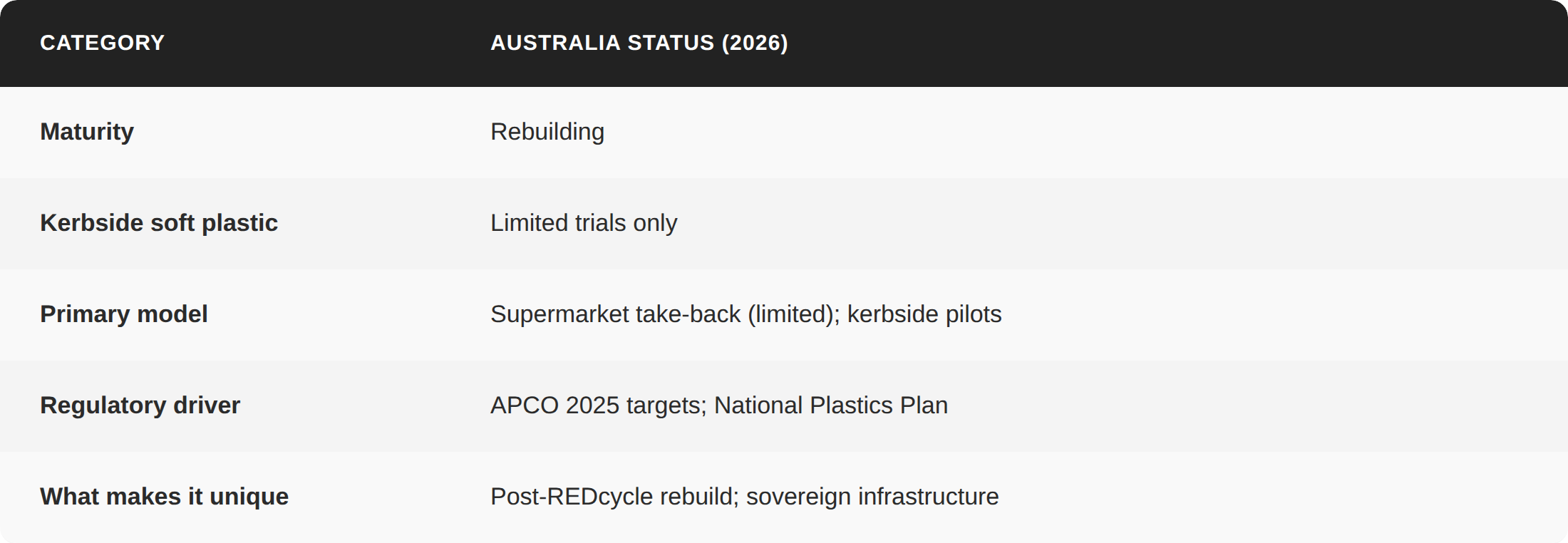
The collapse of REDcycle in 2022 exposed structural weaknesses in a system that had been presented as a solution for a decade. What followed is a rebuilding effort that is more measured, more honest, and better grounded in processing reality. Soft plastic recycling in Australia is not where it needs to be now, but the direction is changing.
Where things stand right now
The REDcycle collapse and its legacy
For over a decade, REDcycle operated Australia's only national soft plastic collection programme, running in-store drop-off bins at Coles, Woolworths, and Aldi locations across 2,000 supermarkets. In late 2022, the programme was quietly suspended after it emerged that it had been stockpiling plastics rather than recycling them.
A fire at Close the Loop, REDcycle's largest processing partner in Melbourne, combined with a pandemic-era collapse in global demand for low-grade recycled plastics, had left the programme with nowhere to send material. An estimated 11,000 tonnes of soft plastic was stockpiled across 44 locations around Australia when REDcycle ceased operations.
The collapse revealed that a national collection system cannot be built ahead of processing capacity, and that end market certainty is as important as collection infrastructure. The rebuilding effort underway since 2022 is working from that lesson.
The current picture
As of 2026, Australia collects and recycles only a small fraction of the soft plastic it generates. Even at REDcycle's peak in 2022, the programme recovered approximately 7,500 tonnes per year. Australia generates over 538,000 tonnes of flexible plastic waste from households and industry annually. The vast majority still goes to landfill.
Soft plastic is not accepted in kerbside recycling bins in most parts of Australia. However, in-store collection has expanded significantly. As of May 2026, Woolworths operates soft plastic collection in over 700 stores across five states, providing access for close to 70% of Australians. The programme has collected and processed 40 million pieces (310,000 kg) since relaunch. Coles and Aldi also continue their own in-store take-back programmes across their respective store networks.
How soft plastic is collected in Australia
The Soft Plastics Taskforce: rebuilding from the ground up
Following REDcycle's collapse, Coles, Woolworths, and Aldi formed the Soft Plastics Taskforce with ACCC approval to collaborate on a solution. The Taskforce assumed responsibility for the legacy REDcycle stockpiles and has been piloting a more cautious, infrastructure-first take-back model.
The sequencing is different from REDcycle: material is only collected when there is confirmed processing capacity to receive it. Early trials were deliberately small-scale to match available processing capacity. As that capacity has grown, so has the collection footprint.
The Soft Plastics Taskforce has since evolved into Soft Plastics Stewardship Australia (SPSA), a formal industry body working with manufacturers including Mars, Nestlé, and McCormick Foods to coordinate collection, processing, and end market development across the supply chain.
The 11,000 tonne stockpile: The ACCC extended interim approval for the Taskforce collaboration partly because, as of July 2024, the legacy REDcycle stockpiles had still not been fully processed. Equipment failures and further incidents at Close the Loop compounded the challenge. Coles, Woolworths, and Aldi have acknowledged the timeline has been longer than expected. The formation of SPSA as a standalone body reflects the industry's commitment to a permanent structure rather than a temporary crisis response.
The National Plastics Recycling Scheme (NPRS)
The longer-term vision is the National Plastics Recycling Scheme, developed by the Australian Food and Grocery Council with federal government funding support from manufacturers including Nestle, Kellogg's, Mars, and Haribo. The NPRS proposes a different collection model from REDcycle: households place soft plastics in a dedicated bag in their yellow recycling bin, the material is extracted from the recycling stream, sorted, cleaned, and sent to processing facilities.
The NPRS is currently in pilot phase across six Local Government Areas in Victoria, New South Wales, and South Australia. A nationwide rollout was initially targeted for late 2024 but has been delayed by the shortage of local processing capacity. As of 2026, expansion depends on new recycling facilities coming online.
Kerbside council initiatives
Several individual councils are independently accepting soft plastics ahead of any national scheme. Randwick Council in Sydney accepts soft plastics for its constituents. Curby on the NSW Central Coast has run a separate kerbside collection that demonstrated strong consumer participation rates. These council programmes cannot address the national volume challenge alone, but they provide useful data on what works.
What actually happens to the material
End markets for collected soft plastic
When soft plastic is collected and processed in Australia, it goes to a growing range of end markets. iQRenew in New South Wales repurposes collected supermarket plastics into hard plastic products including benches, bollards, and posts. Its new NSW facility operates at 14,000 tonnes per year capacity. saveBOARD converts collected soft plastic into building materials, including wall panelling now installed in 170 Woolworths stores. Other processors add shredded soft plastic to concrete or asphalt as a strength additive.
Closed-loop recycling is beginning to emerge. Woolworths' own-brand bread bags now contain 30% recycled soft plastic sourced from its in-store collection programme, processed by Plascrete. This is the first commercially available example in Australia of collected supermarket soft plastic being recycled back into food packaging. It is not yet happening at scale across the industry, but it is no longer accurate to describe closed-loop as absent.
Chemical recycling: the medium-term pathway
Chemical recycling facilities designed specifically for soft plastic feedstocks are now entering development.
- APR Kerbside is operating a pyrolysis pilot plant (WASTX) in partnership with the NPRS, processing post-industrial and post-consumer soft plastics back into a crude oil for remanufacturing into packaging.
- The Licella plant, backed by Amcor and Mondelez International, was slated for commissioning in the second half of 2025 with an initial capacity of 20,000 tonnes per year, scaling to 120,000 tonnes in later phases.
- Recycling Plastics Australia announced a mechanical recycling plant in Adelaide with 14,000 tonnes per year capacity.
- The federal government's Modern Manufacturing Initiative is supporting a facility in Albury capable of processing up to 15,000 tonnes of LDPE annually.
These facilities combined represent processing capacity that exceeds REDcycle's peak throughput. The infrastructure gap exists but it is closing.
What the regulations require and when
APCO targets and the National Packaging Targets
Australia's packaging sustainability targets are set through the Australian Packaging Covenant Organisation (APCO). The targets require
- 100% of Australian packaging to be reusable, recyclable, or compostable by 2025
- 70% of plastic packaging to be recycled or composted by 2025
These targets have not been met for soft plastic. The revised approach acknowledges a staged pathway rather than treating 2025 as a hard enforcement cliff. A national roadmap for harmonising kerbside collections is agreed, with staged improvements toward accepting soft plastics kerbside nationally as infrastructure is built.
What brands must do now
Brands placing flexible packaging on the Australian market are expected to use the Australasian Recycling Label (ARL) correctly. The "Check Locally" label applies to most soft plastic formats that are not currently kerbside recyclable in most areas but may be accepted through take-back. The "Return to Store" label applies to formats accepted in the current supermarket take-back trial.
Review your ARL classifications regularly. The infrastructure position is changing.
What soft plastic recycling in Australia will look like
Three processing facilities coming online (Licella, Recycling Plastics Australia in Adelaide, and Pro-Pac in Albury) represent a combined capacity that exceeds what REDcycle ever handled. For the first time, Australia will have post-consumer soft plastic processing infrastructure designed to receive what the collection system sends. That changes the economics.
Federal investment driving the rebuild
The Modern Manufacturing Initiative has directed over $10 million to soft plastics processing infrastructure. The federal push to resolve the REDcycle situation has translated into facility investment that was absent during its operation. Government funding is de-risking the processing investment that commercial operators need to commit capital.
The NPRS kerbside model
The NPRS kerbside pilot in six LGAs across three states is producing real data on consumer participation, contamination rates, and logistics costs. Early results from comparable pilots in other markets show participation rates three times higher than store drop-off. If the Australian pilot confirms this, the case for a national kerbside soft plastic collection system becomes clear.
Recycled content mandates on the horizon
The change that would most transform Australia's soft plastic recycling economics is mandatory recycled content in packaging. This creates the demand-side market that turns collected soft plastic from a cost centre into a commercial feedstock. Policy discussion is moving in this direction. If mandates are implemented, the processing capacity being built now will have a guaranteed market.
Chemical recycling for complex formats
Chemical recycling handles the mixed, contaminated, and multi-layer soft plastic that mechanical recycling cannot. The technology produces an output oil that can be remanufactured into food-grade plastic packaging. As the Licella plant and similar facilities scale and prove their economics, they provide the processing backbone that REDcycle was built without.
The honest outlook: Australia will not have a nationally functional soft plastic recycling system in 2026. But the system of 2028 to 2030 will look meaningfully different. Brands investing in mono-material recyclable flexible packaging now are aligning with where Australian infrastructure is heading, not just where it is today.
What this means for your packaging decisions in Australia
ARL labelling accuracy is the immediate action
The ARL system requires brands to accurately communicate what consumers can do with their packaging. Most soft plastic formats in Australia should currently carry the "Check Locally" label. Using a standard recycling label on soft plastic that is not kerbside recyclable in most of Australia is a labelling accuracy issue under ACCC guidelines.
Review your ARL classifications regularly as the infrastructure position changes.
Mono-material structures position you for what is coming
The new processing facilities being built for the NPRS are primarily targeting PE-based film streams. Mono-material flexible packaging is better positioned for Australia's emerging recycling infrastructure than multi-layer laminates. If your current flexible packaging uses PET/PE laminates, exploring mono-material alternatives with your supplier is worth prioritising now, ahead of the infrastructure buildout rather than after.
Complex laminates: the chemical recycling pathway
Multi-layer barrier pouches and complex laminates will remain outside Australia's soft plastic recycling stream for the foreseeable future. Chemical recycling offers a longer-term pathway, but commercial scale for post-consumer multi-layer laminates is still years away domestically. Monitor the Licella plant's commissioning closely; it is specifically designed to handle these formats.
Frequently asked questions
What replaced REDcycle after it collapsed?
The Soft Plastics Taskforce, formed by Coles, Woolworths, and Aldi, replaced REDcycle with an infrastructure-first take-back model: material is only collected when processing capacity is confirmed. That model has since expanded significantly. As of May 2026, Woolworths' in-store collection alone operates across 700+ stores in five states, reaching close to 70% of Australians. The Taskforce has since formalised as Soft Plastics Stewardship Australia (SPSA). The longer-term kerbside replacement is the NPRS, currently piloting in six LGAs across three states.
Can I put soft plastic in my yellow recycling bin in Australia?
In most parts of Australia, no. Soft plastic is not accepted in kerbside yellow bins in most councils. A small number of councils, including Randwick in Sydney and some Central Coast councils, have independent programmes that accept soft plastic. Several LGAs are participating in NPRS pilot trials. Check your council's specific guidance as the position is changing.
Sources and further reading
- Woolworths brings back in-store soft plastics collection (May 2026): woolworthsgroup.com.au
- CHOICE soft plastics recycling update (November 2025): choice.com.au
- PKN Packaging News, how are we tracking (2024): packagingnews.com.au
- Clean Up Australia soft plastics overview: cleanup.org.au
- The Conversation, soft plastic recycling after REDcycle: theconversation.com
- APCO National Packaging Targets: apco.org.au
Other posts you may like:
thumbnail.png)

Explore custom packaging solutions
Subscribe to our newsletter
Stay up to date with packaging news and industry updates.


.webp)