


July 17, 2026
Beyond Carbon Neutral: Why We Partnered with SeaTrees to Restore the Ocean
At Grounded Packaging, we have spent years building the tools, materials, and data to help brands make genuinely better packaging decisions. But as our understanding of the climate challenge deepened, we kept arriving at the same uncomfortable conclusion: being carbon neutral is not enough. Neutrality means you are not making things worse. We want to help brands make things better.
That is why we partnered with SeaTrees, a nonprofit focused on restoring coastal and marine ecosystems, to help our customers reach what we call Ocean Positive+ status. It is meaningful offsetting, and it is backed by science.
Quick answer: what is Ocean Positive+ and how is it different from carbon neutral?
Carbon neutral means balancing your emissions, often through credits of variable quality. Ocean Positive+ goes further: through our SeaTrees partnership, each contribution pairs immediate, independently verified carbon sequestration with long-term restoration of mangrove and kelp ecosystems. Blue carbon habitats store carbon at a scale and permanence terrestrial forests struggle to match, and because the projects are coastal, tangible, and measurable, they are far harder to misrepresent than abstract forest-protection credits.
The problem with "carbon neutral"
For a long time, carbon credits were the go-to tool for brands wanting to balance their emissions. Buy credits, fund a project somewhere, call it neutral. Simple enough in theory.
In practice, the model has serious credibility problems. A 2023 investigation by The Guardian found that more than 90% of rainforest carbon offsets approved by Verra, the world's largest certifier, were likely to be worthless, and researchers have repeatedly reached similar conclusions about forestry-based REDD+ schemes. Trees get logged. Forests are displaced rather than saved. Verification is inconsistent. Regulators in the EU and Australia are tightening the rules on what brands can and cannot claim, and consumer trust in offset-based sustainability claims is low.
We felt the tension acutely. Our customers are sophisticated, climate-conscious brands. They use our Life Cycle Assessment data and carbon footprinting tools because they want real answers, not cover. Recommending traditional carbon credits felt like a step backward, so we went looking for something meaningful.
Why blue carbon changes the equation
The answer came from the ocean.
"Blue carbon" refers to carbon stored in coastal and marine ecosystems, primarily mangroves, seagrass beds, and kelp forests. These habitats do not just sequester carbon; they do it at a scale and permanence that terrestrial forests struggle to match. A few numbers worth knowing, drawn from SeaTrees' blue carbon research:
- The ocean is the planet's primary carbon system. It has absorbed roughly a third of human-caused CO2 since the industrial revolution along with the large majority of the excess heat from climate change.
- Mangroves outperform rainforests. Per hectare, mangrove forests sequester carbon at 5 to 10 times the rate of tropical rainforests. Most of that carbon is stored in deep soil and sediment rather than the trees themselves, which makes it far more stable and permanent.
- Kelp forests lock carbon away for centuries. Globally, kelp forests sequester an equivalent volume of CO2 to the world's mangroves. When around 10% of kelp biomass breaks off and sinks into the deep ocean, the carbon it holds is effectively removed from the atmosphere for hundreds of years. Kelp forests also shelter the habitats of more than 700 species of algae, invertebrates, and fish.
In total, blue carbon habitats store far more carbon in their soils and sediments than equivalent areas of terrestrial forest. They also support extraordinary biodiversity and protect coastlines from storm surge and erosion. Coral reefs, often called the rainforests of the sea, are the largest living structures on earth and support around a quarter of all marine life; while their value is biodiversity and coastal protection rather than carbon storage, they are part of the same coastal system this work protects.
This is genuinely new climate infrastructure, and because blue carbon projects are coastal, tangible, and measurable, they are far harder to misrepresent than abstract forest-protection credits.
Who SeaTrees are, and where they are heading
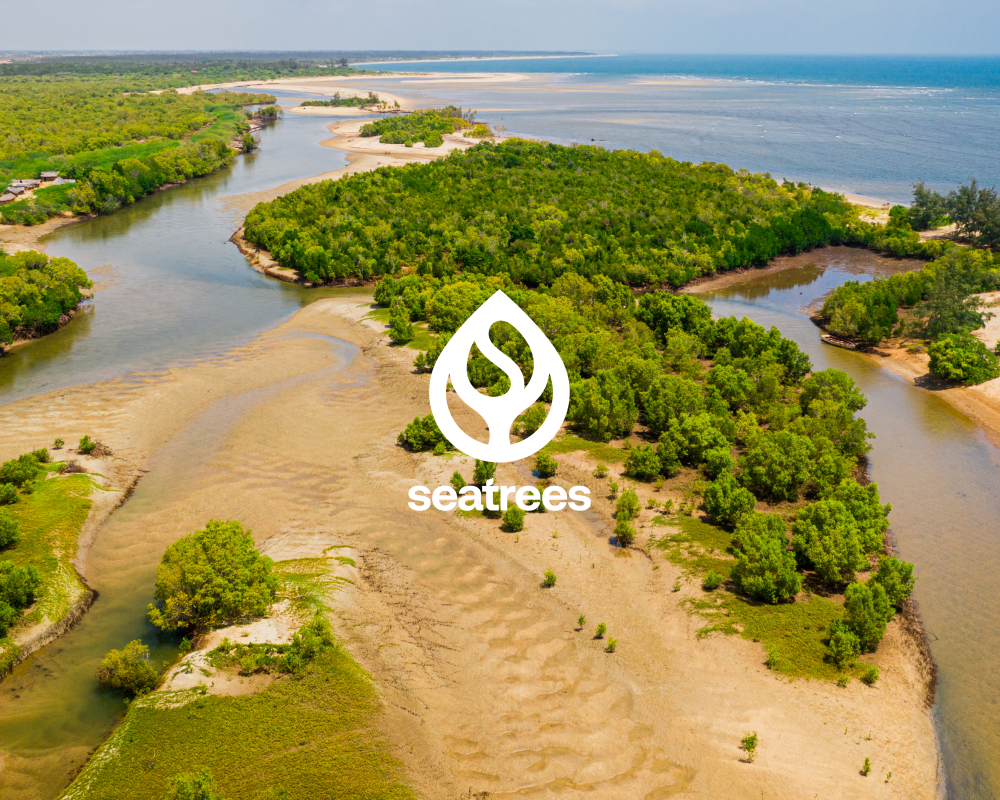
SeaTrees operates at the intersection of climate action and coastal restoration. On World Ocean Day in June 2024 they announced their second major milestone, 4 million SeaTrees planted and protected, and at the time of publishing, they have now planted 4.8 million seatrees. Their longer-term goal is to support 100 blue carbon projects in threatened coastal ecosystems by 2030 and become a global leader in developing them.
The urgency is the point. The scientific consensus is that this decade is the critical window to cut our collective carbon footprint and avoid passing dangerous climate tipping points. Thousands of people and hundreds of brands have already joined that effort, and the partnership is how we bring our customers into it.
What the SeaTrees partnership actually delivers
Our partnership is built around the SeaTrees Token model. Each token funds three interconnected actions:
- Immediate carbon sequestration. The Southern Cardamom REDD+ Project in Cambodia balances 1 metric ton of CO2 emissions. This is the kind of project the credibility concerns above are aimed at, which is exactly why it matters that it carries dual certification under the Verified Carbon Standard (VCS) and the Climate, Community and Biodiversity Alliance (CCBA), two of the most rigorous independent standards in the industry.
- Mangrove planting in West Papua, Indonesia. Four trees are planted per token, with the potential to sequester an additional 1.2 metric tons of CO2 over 25 years. These are not symbolic plantings. They are part of a long-term coastal restoration programme with community involvement built in from the start.
- Kelp forest restoration in Palos Verdes, California. One square foot of giant kelp forest is restored per token, protecting marine biodiversity and contributing to long-term deep-ocean carbon storage.
The combination of immediate action and long-term regeneration is what separates this from a conventional offset. You are not just balancing a number, you are contributing to functional ecosystem restoration.
Why this matters for packaging specifically
Packaging has a complicated end-of-life story. Even when a brand chooses the most sustainable material available, what happens to it after disposal matters enormously, and real-world collection does not always go to plan.
The SeaTrees partnership acts as a safeguard. By pairing verified carbon sequestration with our Scope sustainability reporting and carbon footprinting tools, we can help brands understand their total packaging footprint and keep their climate impact net positive even when disposal falls short of the ideal.
The wider impact: people, communities, and biodiversity
The Ocean Positive+ framework aligns with several UN Sustainable Development Goals (SDGs), and the impact extends well beyond carbon:
- Climate action and ocean health (SDGs 13 and 14): direct sequestration and marine habitat restoration at scale.
- Health and wellbeing (SDG 3): the Southern Cardamom project provides healthcare access to over 16,000 people in Cambodia.
- Jobs and economic growth (SDG 8): the programme supports more than 200 local jobs in conservation and restoration.
- Community infrastructure (SDGs 9 and 10): funding goes toward education and sustainable development in the regions where projects operate.
- Biodiversity protection: critical habitats for endangered species are preserved, including the Malaysian sun bear and the Irrawaddy dolphin.
Honest about what offsetting can and cannot do
We want to be straight about this. Offsetting and restoration are not perfect, and on their own they will not solve the climate crisis. They do not cancel out a footprint, and they are no substitute for cutting emissions at the source. Reducing the impact of the packaging itself, through better materials, less material, and recyclable design, always comes first. What verified blue carbon restoration offers is a credible, measurable step in the right direction for the emissions that remain. It is a step worth taking, and being honest about both what it does and what it does not do is the whole point. The moment offsetting becomes a way to avoid harder changes rather than support them, it stops being useful.
What this means for you and your brand
If you work with Grounded Packaging, this partnership gives you access to a level of climate credibility that is increasingly rare: verified, science-backed, multi-ecosystem restoration rather than a line item on a spreadsheet. As greenwashing rules tighten across the UK, EU, and Australia, that difference between a defensible restoration story and an abstract offset is becoming a commercial one, not just an ethical one.
The next decade is the critical window for avoiding the worst outcomes of climate change, and packaging has a real role to play. This is how we are playing ours. To explore what Ocean Positive+ packaging looks like for your brand, get in touch with our team, read more about our blue carbon work, or start with the numbers using our Packaging Footprint Calculator.
Other posts you may like:
thumbnail.png)

Explore custom packaging solutions
Subscribe to our newsletter
Stay up to date with packaging news and industry updates.


.webp)