



July 1, 2026
EU Packaging Compliance for Non-EU eCommerce Brands: 2026 Guide
If you are an eCommerce brand shipping garments to customers within Europe from outside Europe, you have packaging compliance obligations in the EU. This applies whether you are based in Australia, the US, the UK, or anywhere else.
Many brands do not realise those obligations are live right now. They are not waiting for PPWR or some future regulation to kick in. National EPR schemes have been operating across the EU for years, and non-EU sellers are included.
There are two layers to understand: the national EPR schemes already running in each EU country, and the new EU-wide Packaging and Packaging Waste Regulation (PPWR, Regulation 2025/40) that takes full effect from August 2026.
Key facts at a glance
- EU packaging EPR obligations apply to all brands shipping packaged goods to EU consumers, regardless of where the brand is based.
- Registration is per country. There is no single EU-wide packaging EPR registration.
- Germany (LUCID), France (CITEO/Léko), Italy (CONAI), and Spain (Ecoembes) all have live, enforceable programmes now.
- Amazon and major EU marketplaces enforce EPR registration numbers as a condition of selling. Non-compliance triggers listing suspension.
- From 12 August 2026, PPWR requires a formal EU-based authorised representative per country.
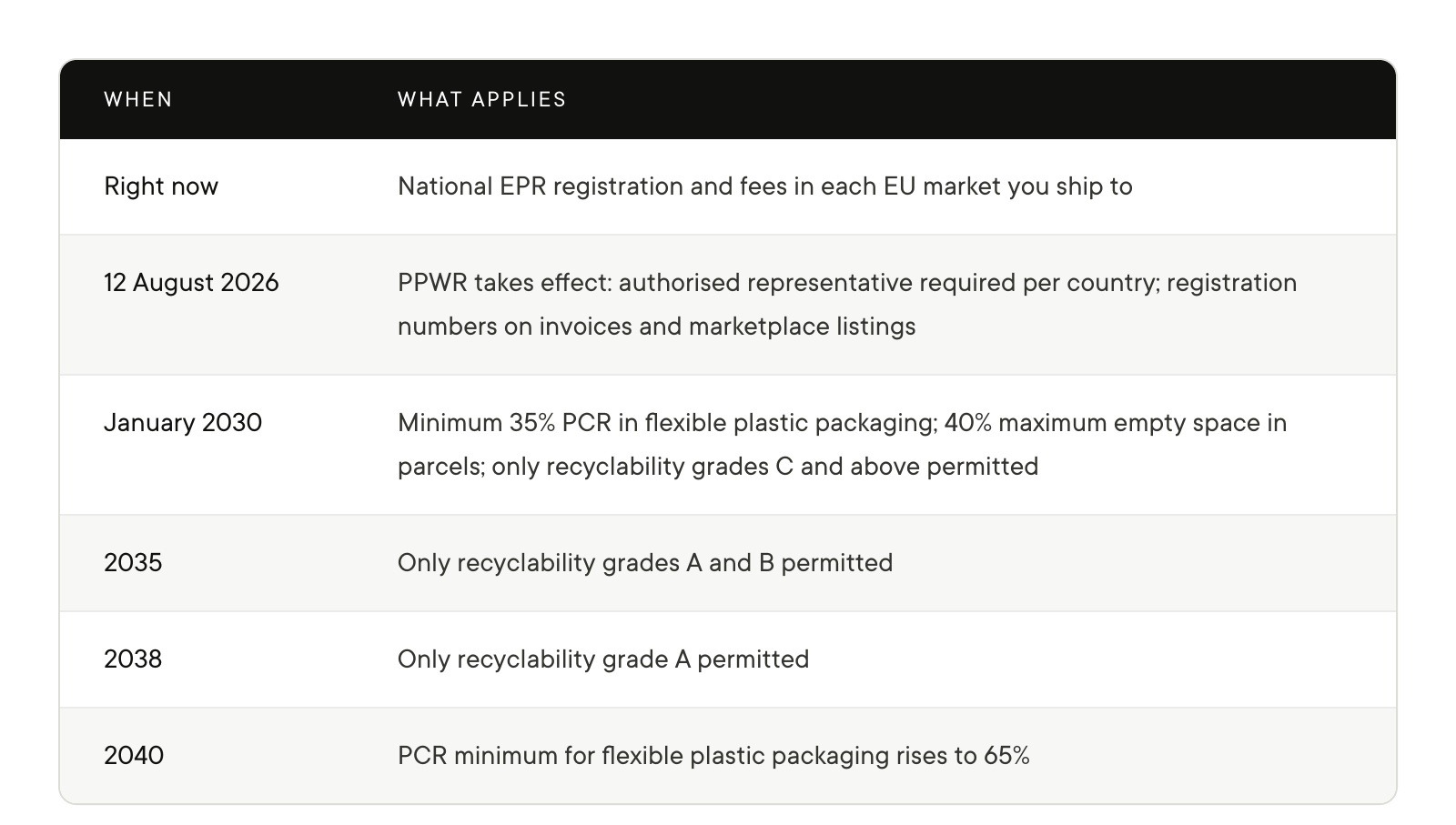
- From January 2030: minimum 35% post-consumer recycled (PCR) content in flexible plastic packaging; recyclability grade C or above required.
Key definitions
EPR (Extended Producer Responsibility): A regulatory model that makes the companies placing packaging on a market financially responsible for its end-of-life recycling. In practice: register in each country you sell into, declare your packaging volumes annually, and pay fees per kilogram into a national recycling fund.
PPWR (Packaging and Packaging Waste Regulation): EU Regulation 2025/40, which came into force in February 2025 and is the new EU-wide packaging law. Most provisions apply from 12 August 2026. It covers packaging design, recyclability, recycled content, and the obligations of non-EU sellers placing packaging on EU markets.
PCR content (Post-Consumer Recycled content): The proportion of a packaging material that comes from recycled post-consumer waste, such as previously used plastic. PPWR sets minimum PCR requirements for flexible plastic packaging from 2030.
EU authorised representative: An EU-based legal entity or individual who accepts legal responsibility for a non-EU brand's EPR registration, reporting, and fee obligations in a given EU member state. Required under PPWR from 12 August 2026, on a per-country basis.
Which EU countries require EPR registration for packaging?
Most major EU markets have had live packaging EPR schemes for years. If you ship packaged goods to consumers in any of these countries, you are considered a producer under their national laws. You are expected to register, report your packaging volumes, and pay recycling fees.
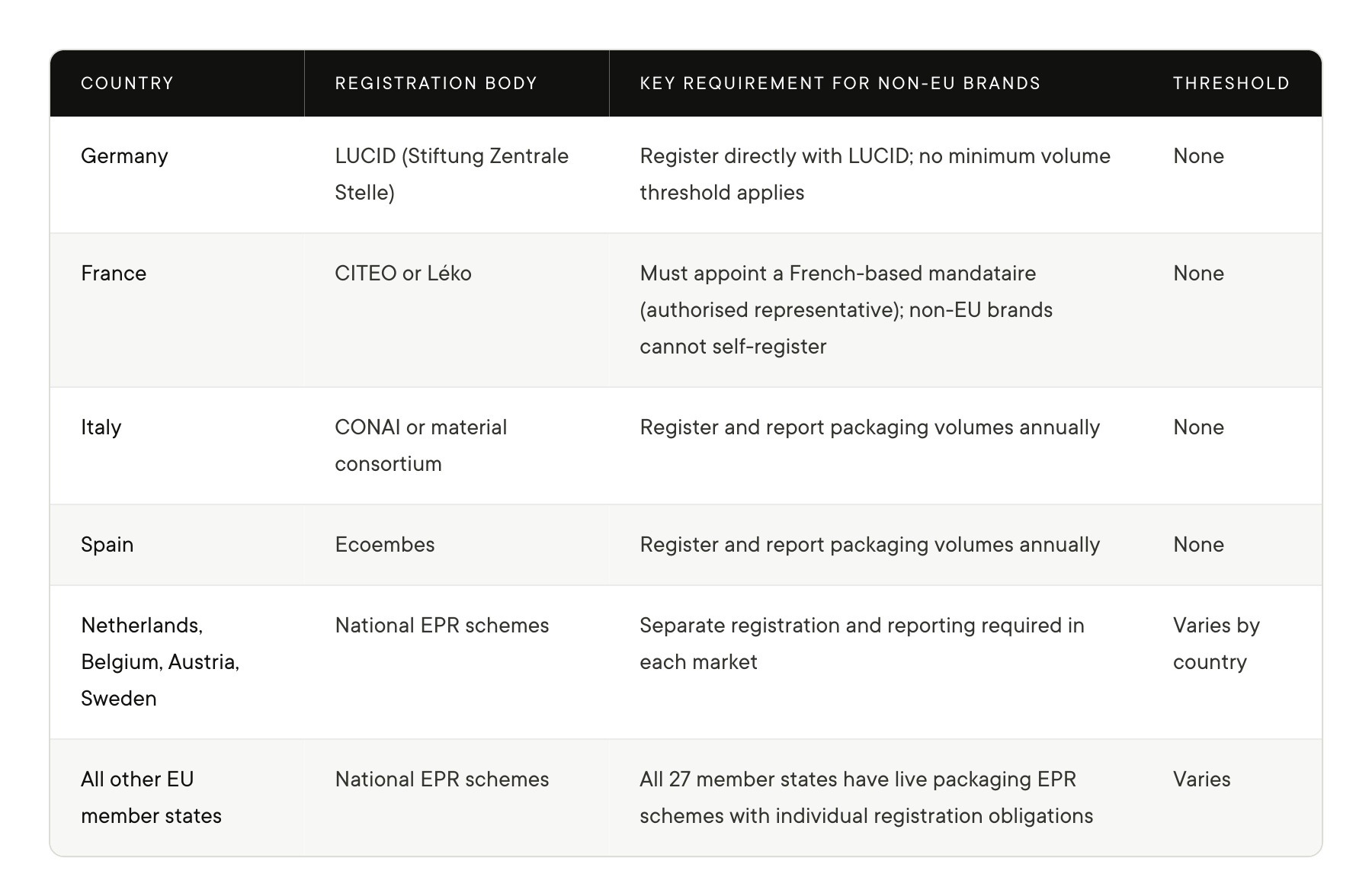
Registration is per country, not EU-wide. Each market requires a separate registration, separate annual reporting, and separate fee payments based on the weight of packaging you place on that market.
Marketplace enforcement: Amazon, Zalando, and others
Amazon, Zalando, and other major EU marketplaces now enforce EPR registration numbers as a condition of listing. If you cannot provide a valid registration number for each country you sell into, your listings can be suspended. This enforcement typically happens before any national regulator gets involved.
For e-commerce fashion brands, marketplace suspension is often the moment compliance becomes urgent. Retroactive registration is possible but takes time, during which your products are off sale. Registering proactively, before a marketplace flags the absence of a registration number, avoids that disruption.
What does PPWR require from non-EU brands from August 2026?
The EU Packaging and Packaging Waste Regulation (PPWR, Regulation 2025/40) came into force in February 2025. Most provisions apply from 12 August 2026. For non-EU e-commerce fashion brands, the key new requirements are:
- Formal authorised representative per country. You must appoint an EU-based authorised representative in each country where you sell. This person or entity accepts legal responsibility for your EPR registration, reporting, and fee obligations in that market. This is a per-country appointment, not a single EU-wide role. It is a legal requirement, not optional.
- Registration number on documentation. Your producer registration number must appear on invoices and marketplace listings from 12 August 2026.
- Recyclability by design. Full recyclability grading requirements apply from 2030, but packaging design decisions made now should be moving toward compliance with those grades.
What is an EU authorised representative and what do they do?
An EU authorised representative is a legal entity or individual based in an EU member state who formally accepts responsibility for your brand's EPR obligations in that country. They handle registration with the national packaging register, submit annual volume reports on your behalf, and pay the corresponding EPR fees. Appointing one does not remove your brand's underlying legal obligation. It creates a compliant structure for meeting it as a non-EU entity.
Services that act as authorised representatives for non-EU e-commerce brands operate in most major EU markets. Fees vary by market and packaging volume. For most fashion e-commerce brands with modest packaging volumes, the combined annual cost across Germany and France is typically the most significant.
PPWR 2030 requirements: recycled content and recyclability for plastic mailers
From January 2030, the following requirements apply to flexible plastic packaging, including e-commerce mailer bags and garment polybags:
- Minimum 35% post-consumer recycled (PCR) content, rising to 65% by 2040
- Maximum 40% empty space in e-commerce parcels
- Recyclability grade C or above to be placed on the EU market. Grade D and ungraded packaging cannot be sold. Requirements tighten to grade B or above from 2035, and grade A only from 2038.
If you are already using recycled plastic mailers with 35% or more PCR content, you are ahead of the 2030 requirement. Get your supplier's PCR certification in writing now and keep it on file. You will need that documentation for compliance reporting and for any recyclability claims under EU green claims rules.
Garment polybags are treated as flexible plastic packaging under PPWR and face the same requirements. Single-material PE polybags generally perform well on recyclability grading. Multi-layer or heavily printed bags may face challenges as the grading methodology is finalised.
What happens if you do not comply?
National EPR non-compliance is enforced at the member state level, and the consequences vary by country.
- Germany: Non-compliance with LUCID registration obligations can result in a sales ban on your products and civil penalties. The Stiftung Zentrale Stelle actively investigates and enforces.
- France: Non-registration or failure to appoint a mandataire can result in administrative fines and removal from sale. France's CITEO system has formal enforcement mechanisms.
- Marketplace suspension: As noted above, Amazon and major EU platforms enforce EPR registration independently of regulators. Loss of marketplace access is often the first practical consequence of non-compliance.
- PPWR from August 2026: Failure to appoint a country-level authorised representative is a breach of EU law that applies directly to the brand owner. Enforcement is managed by member state authorities.
Non-compliance is a commercial risk as much as a regulatory one. Marketplace suspension during a peak trading period is a material revenue event.
The timeline at a glance
What to do now
- Map your EU markets. Identify every country you ship to and approximate packaging volumes. You will need packaging weight data per market for reporting.
- Register in Germany and France first. These are the most actively enforced markets and the standard starting point for non-EU brands.
- Engage an EPR compliance provider. Multi-country packaging EPR registration is not straightforward to manage alone. Several services operate specifically for e-commerce brands selling into the EU.
- Request PCR content documentation from your packaging supplier. You need this for compliance reporting and for demonstrating alignment with the 2030 recycled content targets.
- Appoint country-level authorised representatives before August 2026. This is a legal requirement under PPWR. Allow time to identify, brief, and formally appoint a representative in each market before the deadline.
The core obligations are straightforward: register where you sell, report what you ship, pay the fees, and ensure your packaging is moving toward recyclability. Brands that treat this as a background administrative task tend to discover it at the worst possible time, when a marketplace suspends their listing or a market authority issues a notice.
Frequently asked questions
Do I need to register for EU packaging EPR even if I ship directly from Australia to EU customers?
Yes. EU packaging EPR obligations are based on where the packaging enters the consumer market, not where the brand is headquartered. If you are shipping packaged goods to consumers in Germany, France, Italy, or any other EU member state, you are considered a producer under their national EPR laws and are required to register, report your packaging volumes, and pay recycling fees in each market. Shipping from outside the EU does not exempt you.
What is an EU authorised representative for packaging, and do I need one?
An EU authorised representative is a legal entity or individual based in an EU member state who formally accepts responsibility for your brand's EPR registration, reporting, and fee obligations in that country. From 12 August 2026, appointing one per country is a legal requirement under PPWR for all non-EU brands placing packaging on EU markets. This is not optional. If you already work with an EPR compliance provider in Germany or France, check whether that provider can also act as your PPWR authorised representative or whether a separate appointment is needed.
Does PPWR apply to brands based outside the EU?
Yes. PPWR applies to all packaging placed on EU markets, regardless of where the brand is based. If your packaging enters the hands of an EU consumer, PPWR's requirements apply to you: authorised representative appointment, registration number on documentation, and the 2030 recycled content and recyclability requirements. There is no exemption for brands based in Australia, the US, the UK, or any other non-EU country.
My plastic mailers are already made from recycled plastic. Does that help?
Yes, and it may mean you are already ahead of the 2030 minimum recycled content requirement. Under PPWR, e-commerce mailer bags must contain at least 35% post-consumer recycled (PCR) content from January 2030. If your mailers already meet or exceed that threshold, document it now. Get your supplier's PCR certification and keep it on file. You will need that evidence for compliance reporting, and potentially for any recyclability claims under EU green claims rules.
Is there a single EU registration, or do I need to register separately in every country?
Currently, registration is per country. There is no single EU-wide packaging EPR registration. A centralised EU registry is in development but no confirmed operational date has been set. Until it exists, if you sell into Germany, France, Italy, and Spain, you need four separate registrations, four separate annual reports, and four separate fee payments. Working with an EPR compliance provider that covers multiple EU markets is the most practical approach for most e-commerce brands.
Other posts you may like:
thumbnail.png)

Explore custom packaging solutions
Subscribe to our newsletter
Stay up to date with packaging news and industry updates.


.webp)