



May 20, 2026
US Packaging EPR: The Complete State-by-State Guide for Brands
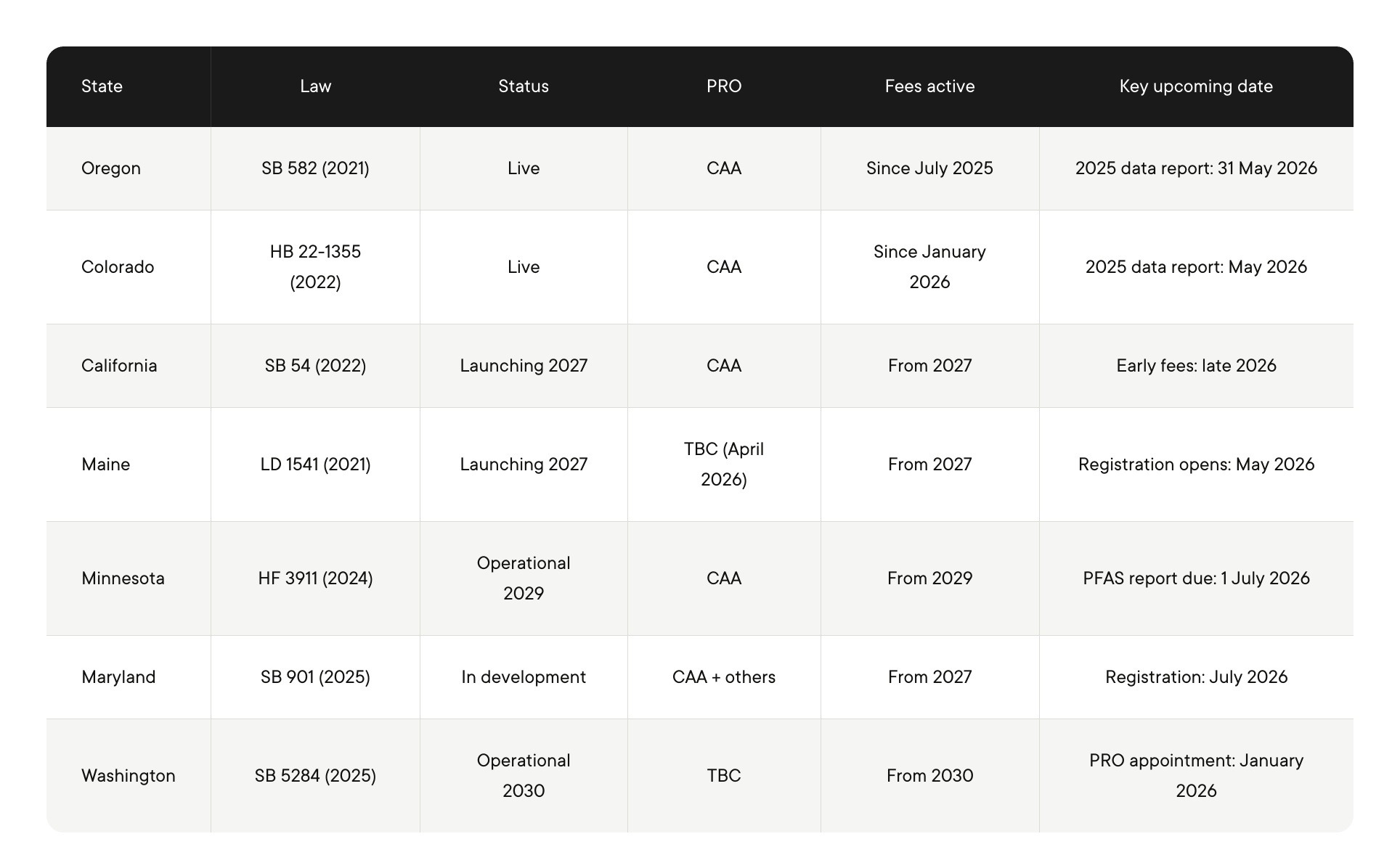
Seven US states now have packaging extended producer responsibility (EPR) laws on the books. Two are already collecting fees. A third launched in January 2026. And the others are building toward operational dates between 2027 and 2030.
If your brand sells packaged goods in the United States, this is no longer a future compliance consideration. It is a current commercial reality, and the brands that understand and embrace it earliest will pay significantly less than those that do not.
This guide covers every active US packaging EPR programme: who is in scope, what each state costs, what packaging is exempt, and the practical steps to get ahead of your obligations. For a broader introduction to how EPR works and what it means for flexible packaging brands specifically, start with our US packaging EPR overview here.
What is EPR, and why does it matter for your business?
Extended Producer Responsibility is a regulatory framework built on the polluter pays principle: the brands that put packaging into the market fund the system that manages it at end of life. Historically, those costs sat with local governments and, ultimately, taxpayers. EPR shifts them to producers.
That shift is significant. For most packaging-intensive businesses, EPR fees will be a meaningful line item and not an immaterial compliance cost. Oregon's first-cycle fees ranged from $0.08 to $0.77 per pound, a ten-times spread that reflects how differently recyclable and non-recyclable packaging is treated.
That spread is the commercial opportunity inside EPR. It is not a flat tax. It is a fee structure that rewards packaging designed for recyclability and penalises packaging that creates costs for municipal waste systems. The brands that redesign now, ahead of full fee rollout, will build a durable cost advantage over competitors that do not.
The mechanism that drives this is called eco-modulation: the adjustment of base fees up or down based on packaging performance. Understanding eco-modulation is essential to managing your EPR cost position. Read our full eco-modulation guide here.
How a PRO works: A Producer Responsibility Organization (PRO) is the body you register with and pay fees to. It collects fees from all registered producers, then uses that money to fund recycling infrastructure, reimburse municipalities, and run the programme. The Circular Action Alliance (CAA) is the PRO across most active US states. Registering with CAA once gives you a single point of compliance for Oregon, Colorado, California, Minnesota, and Maryland.
TLDR: what brands need to do now
This is the shortest version of this guide. If you are already selling into any active or launching US EPR state, these are your non-negotiable near-term actions.
- Confirm if you are obligated. If you sell into California, Oregon, or Colorado, you may be obligated. Each state has different definitions of producer. Check exemption thresholds of each state.
- Register with CAA at circularactionalliance.org. If you are not yet registered, you are already in enforcement risk territory. Registration is the first compliance obligation in every US EPR state.
- Pull your packaging data by state. You need the weight of each packaging type placed on the market in each state, by material category. If you do not have this, start now. The data goes back to 2023 for California and 2024 for Oregon and Colorado.
- Check whether you missed a reporting deadline. Oregon, Colorado, and California's next reporting deadlines are May 31, 2026. Ensure you log reporting deadlines into your Business-As-Usual reporting cadences.
- Submit your packaging data to CAA. Ensure you submit by each deadline, and use the resources available to you via CAA's portal.
- Monitor upcoming registration windows. Maine's programme registers producers from May 2026. Washington requires PRO appointment by January 2026. Minnesota's fees do not begin until 2029 but registration was required by July 2025.
- Design your packaging portfolio for EPR. Knowing where your portfolio sits tells you your fee exposure and where redesign investment pays off most. Reach out to our team here about solutions.
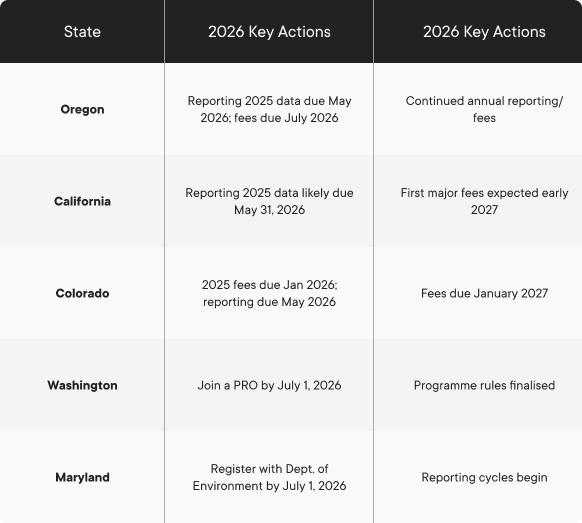
State EPR programme status at a glance
Who is a producer? The cross-state definition
Every US EPR state uses its own statutory language, but the core definition is consistent: you are a producer if your brand places covered packaging on the market in that state. That means you are responsible for fees and reporting obligations, regardless of where you are headquartered.
The key principles that apply across all seven states:
- E-commerce brands are in scope. If you ship packaged products to consumers in a state, you are a producer in that state. Being based in another state, or outside the US entirely, does not exempt you. Your shipping materials (mailers, boxes, tape, void fill) are also covered, not just your product packaging.
- Brand owners carry the obligation. The fee obligation sits with the brand whose name appears on the packaging, not with the contract manufacturer or packaging supplier that made it.
- Consumer packaging is the primary target. Maine's 2025 amendment explicitly exempts B2B and industrial packaging. Oregon covers shipping materials used to deliver to consumers. In ambiguous cases, the test is whether the packaging ends up in a consumer's hands.
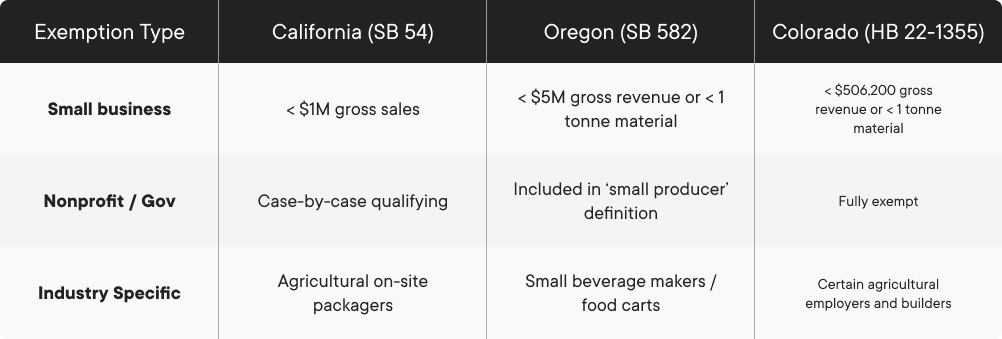
- There is no universal de minimis exemption. Some states have small producer thresholds (Maine has the most explicit: under $2 million annual revenue, or under 1 tonne of packaging per year). Others have thresholds set in programme documentation rather than statute. Do not assume you are below the threshold without checking the current criteria for each state where you sell.
State-by-state guidance
California

California's programme is the most ambitious in the US. It does not just collect fees, it mandates a 25% reduction in single-use plastic packaging by 2032, with no more than 8 percentage points of that reduction coming from adding recycled content. The other 17 percentage points require using genuinely less plastic.
Who is in scope: Any brand selling or distributing single-use packaging or plastic food service ware into California. Importers and e-commerce brands shipping to California are fully in scope.
What is exempt: Beverage containers covered by California's bottle deposit law, prescription drug packaging, infant formula packaging, medical and hazardous materials packaging, and genuinely reusable packaging (designed for multiple uses).
Fee position: California uses CalRecycle's Covered Material Category (CMC) framework to set fee tiers, which have just been published publicly. Mono-material laminates and films have a lower fee than multi-material laminates. Corrugated cardboard and uncoated paper are in the lowest fee band. Certified compostable flexible film qualifies for a mid-tier compostable classification if correctly certified (EN 13432 or ASTM D6400) and labelled.
Plastic reduction target: California's 25% plastic reduction target by 2032 is the most significant design obligation of any US state. 65% of all single-use plastic packaging is to be recycled. Compostable plastic does not automatically count toward the reduction target.
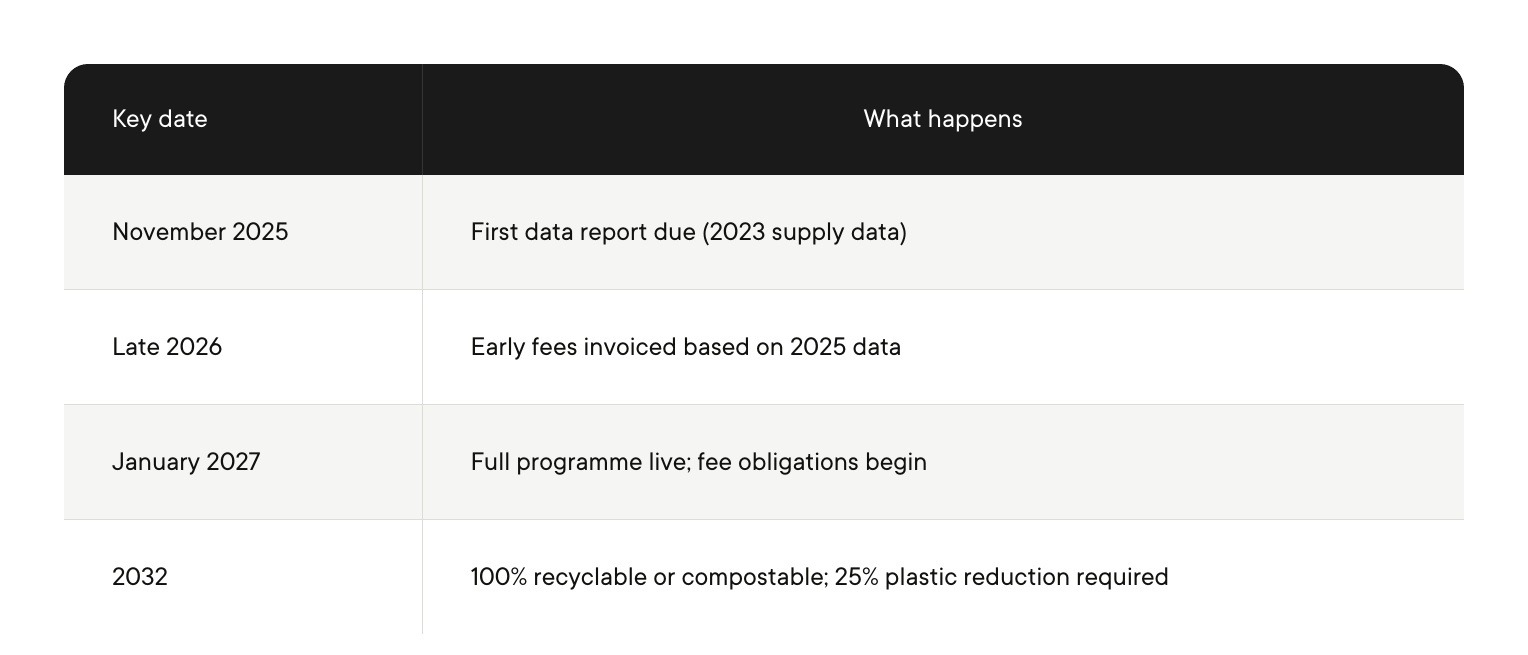
What to do now: Register with CAA if you have not already. If you missed the November 2025 data report, contact CAA. Begin mapping your CMC categories for each packaging format.
Oregon

Oregon was the first US state to collect packaging EPR fees. Enforcement is active. Non-registered producers can be barred from selling in Oregon.
Who is in scope: Any brand selling or shipping packaged goods to Oregon consumers or businesses, including e-commerce. Printing and writing paper is uniquely covered as a separate category in Oregon. If your business produces paper-based marketing materials or brochures placed on the Oregon market, those are in scope.
What is exempt: Oregon does not publish a long exemption list. Small producer thresholds exist but are set in program plan documents. Check CAA's Oregon documentation for current criteria.
Fee position: Oregon's first-cycle fees ranged from USD $0.08 to $0.77 per pound. Flexible plastic film and multi-layer laminates are not on Oregon's Uniform Statewide Collection List (USCL) and sit in the highest tier. Corrugated and uncoated paper are on the USCL and sit in the lowest tier. Oregon's eco-modulation goes further than any other state: the largest producers must submit a Life Cycle Assessment (LCA), and smaller producers can do so voluntarily for additional fee reductions.
Oregon's responsible end market standard. Oregon requires the PRO to verify that collected materials reach real processors, not just kerbside collection. Recyclability claims for flexible packaging need to hold up to this higher bar.
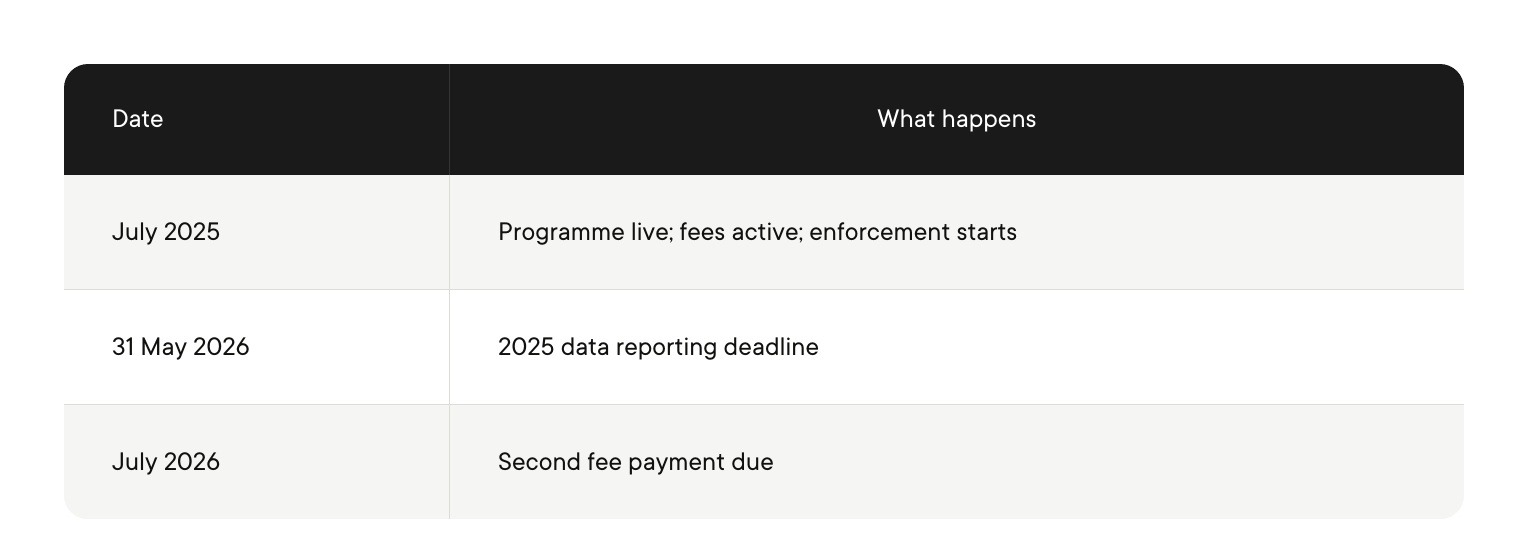
What to do now: Register with CAA immediately if not already done. Contact CAA urgently if you missed the July 2025 fees.
Colorado

Colorado became fully operational on 1 January 2026, with eco-modulation rules in effect. Colorado has the broadest paper scope of any US state, covering all printed paper products including newspapers, magazines, and brochures alongside packaging.
Who is in scope: Any brand selling or distributing covered packaging or paper products to consumers in Colorado, including e-commerce.
What is exempt: Small producers below CDPHE's defined revenue or volume thresholds may qualify for reduced obligations. Being below the threshold does not automatically exempt you from registration.
Fee position: Colorado's eco-modulation bonus schedule includes fee credits of up to 10% for PCR content above a defined threshold, packaging weight reduction, reuse or refill systems, and accurate recyclability labelling. If your packaging already includes verified PCR content or has been lightweighted, document this to claim the available bonuses.
Colorado rewards lightweighting directly. Unlike some states, Colorado's eco-modulation specifically credits weight optimisation. If your flexible packaging can be reduced in weight without compromising product integrity, this reduces your Colorado fee through the bonus mechanism.

What to do now: Register with CAA and pay any outstanding fees.
Maine

Maine was the first US state to pass a packaging EPR law, but it takes a different structural approach from most: producer fees reimburse municipalities for what they already spend on recycling, rather than funding a new PRO-run system.
Who is in scope: Brand owners and primary importers of consumer-facing packaged products sold in Maine. Maine has the most explicit small producer exemptions in the US: producers with annual revenues below $2 million, or placing less than 1 tonne of consumer packaging per year in Maine, are exempt entirely.
What is exempt: The 2025 amendment to Maine's law explicitly excluded B2B and industrial packaging. Check whether your packaging is consumer-facing or B2B to confirm your scope accurately. The small producer exemptions ($2 million revenue / 1 tonne volume) are the clearest in the US.
Fee position: Maine's fee structure is not yet confirmed.
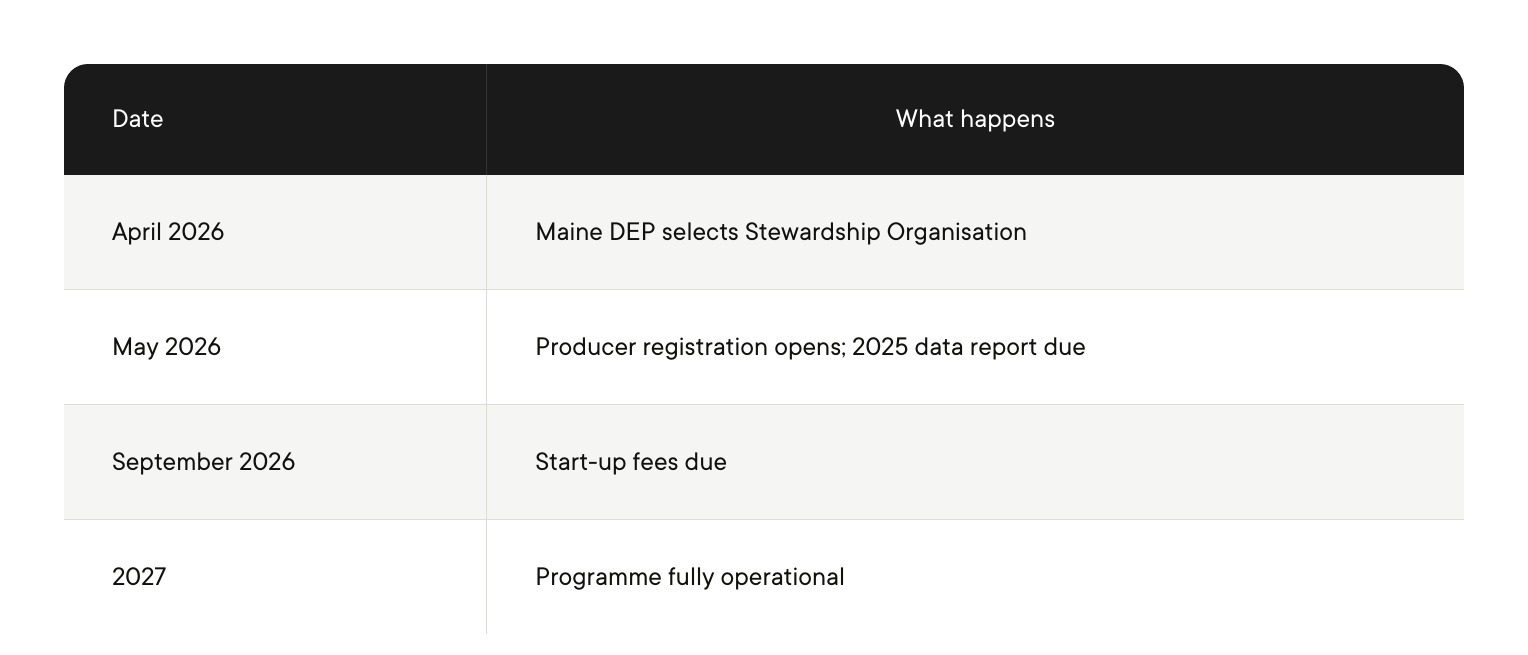
What to do now: Check whether you meet the small producer exemption thresholds. If not, monitor Maine DEP announcements for the April 2026 SO selection. Prepare your 2025 packaging data by state now.
Minnesota

Minnesota's fees do not begin until 2029, but producers were required to designate a PRO from January 2025 and register with CAA by July 2025. There is also a separate and immediate obligation under Minnesota's Amara's Law: if your packaging contains intentionally added PFAS (fluorinated barrier coatings, grease-resistant treatments), you must report to the MPCA by 1 July 2026.
Who is in scope: Any brand selling consumer-packaged products or shipping e-commerce orders to Minnesota. Minnesota mandates PRO membership for all producers: there is no individual compliance plan option, unlike Washington and Maryland.
What is exempt: Some printed materials have exemptions; check MPCA guidance. Boat wrap is uniquely covered as a specific format in Minnesota.
The PFAS connection. If your packaging uses fluorinated coatings for oil or grease resistance, you have two overlapping obligations: the Amara's Law reporting deadline (1 July 2026), and an expected eco-modulation malus under the EPR programme from 2029. Eliminating PFAS from your packaging addresses both in one move.
Minnesota's 2032 standard is the most demanding in the US. All covered packaging must be reusable, refillable, recyclable, or compostable. Every individual format must have a functional end-of-life pathway.
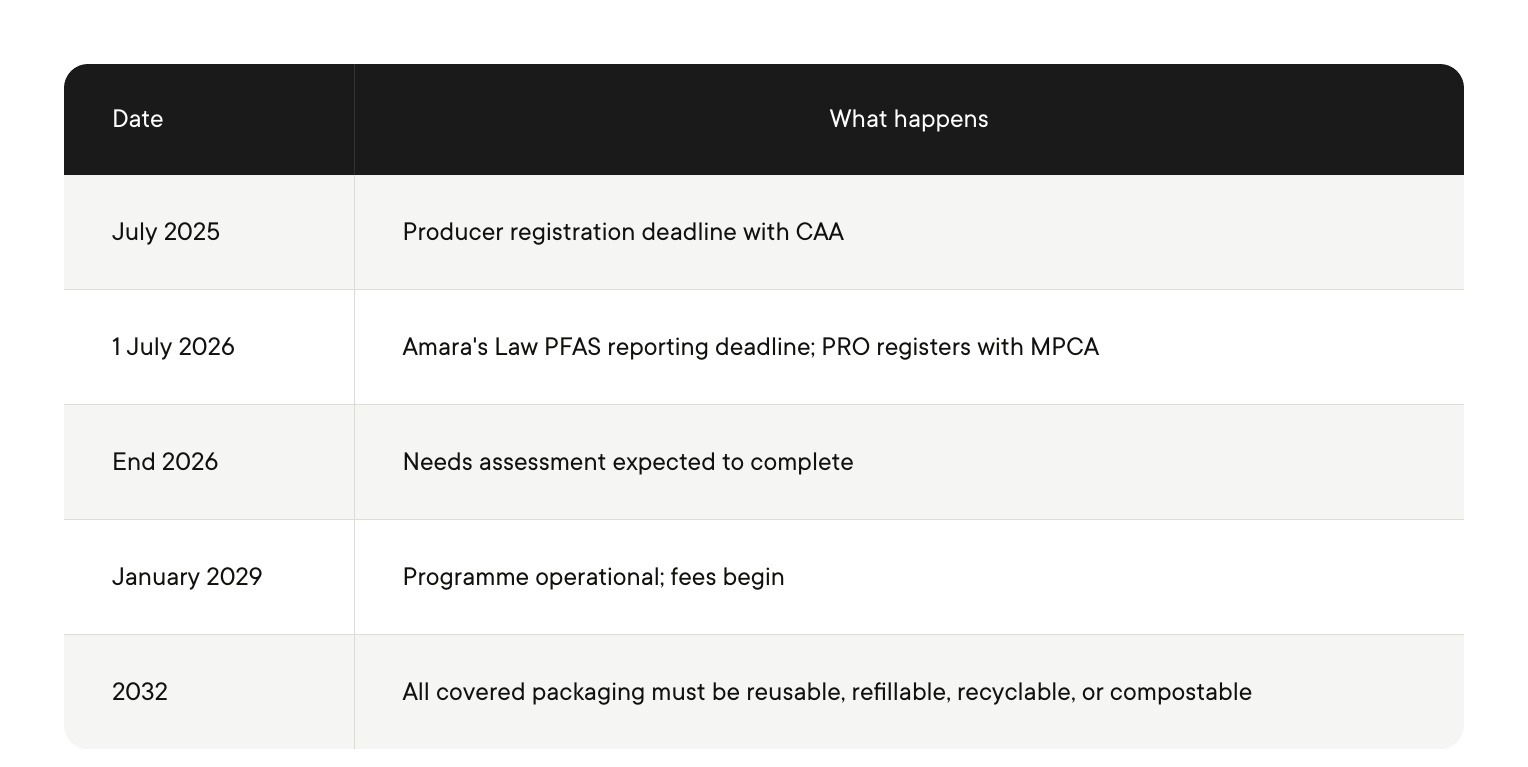
What to do now: Register with CAA if you have not already. Check your packaging for intentionally added PFAS and assess your Amara's Law obligations before 1 July 2026.
Maryland

Maryland's law was signed in May 2025 and was designed on the back of a formal statewide Recycling Needs Assessment. Maryland is unique in allowing multiple PROs to operate simultaneously, and in offering producers the option of submitting an individual compliance plan rather than joining a PRO.
Who is in scope: Any brand selling consumer-packaged products or shipping e-commerce orders to Maryland. Food and beverage containers are explicitly named as covered materials.
What is exempt: Some printed materials have exemptions, to be confirmed in rulemaking. Individual compliance plan option is available if your business has a sufficiently developed sustainability programme.
Fee position: Maryland uses a municipal cost-reimbursement model like Maine. Fees will be confirmed when program plans are approved in 2027. The prior needs assessment makes Maryland's fee levels more likely to be grounded in actual municipal costs than most states at launch.
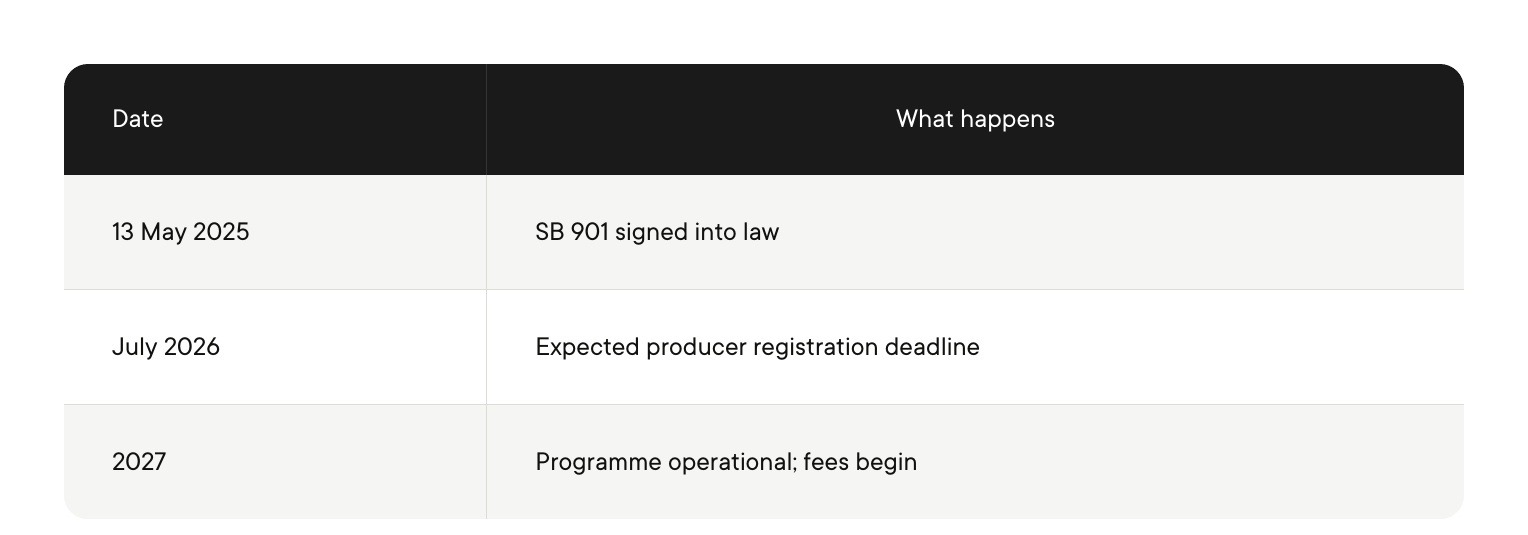
What to do now: Monitor MDE announcements for rulemaking progress. Decide whether to join CAA or assess whether an individual compliance plan suits your business. Prepare 2024 and 2025 packaging data by state.
Washington

Washington gives brands the longest lead time of any US state: fees do not begin until 2030. But early PRO appointment and registration obligations start now. Only 58% of Washington jurisdictions currently have kerbside recycling, meaning a significant portion of producer fees will fund infrastructure expansion. This may push fees higher in the early years.
Who is in scope: Any brand selling or distributing covered packaging to consumers in Washington, including e-commerce. Washington, like Maryland, allows individual compliance plans as an alternative to joining a PRO.
What is exempt: Some printed materials have exemptions, to be confirmed in rulemaking from 2026.
Fee position: Fees will not be confirmed until October 2028.
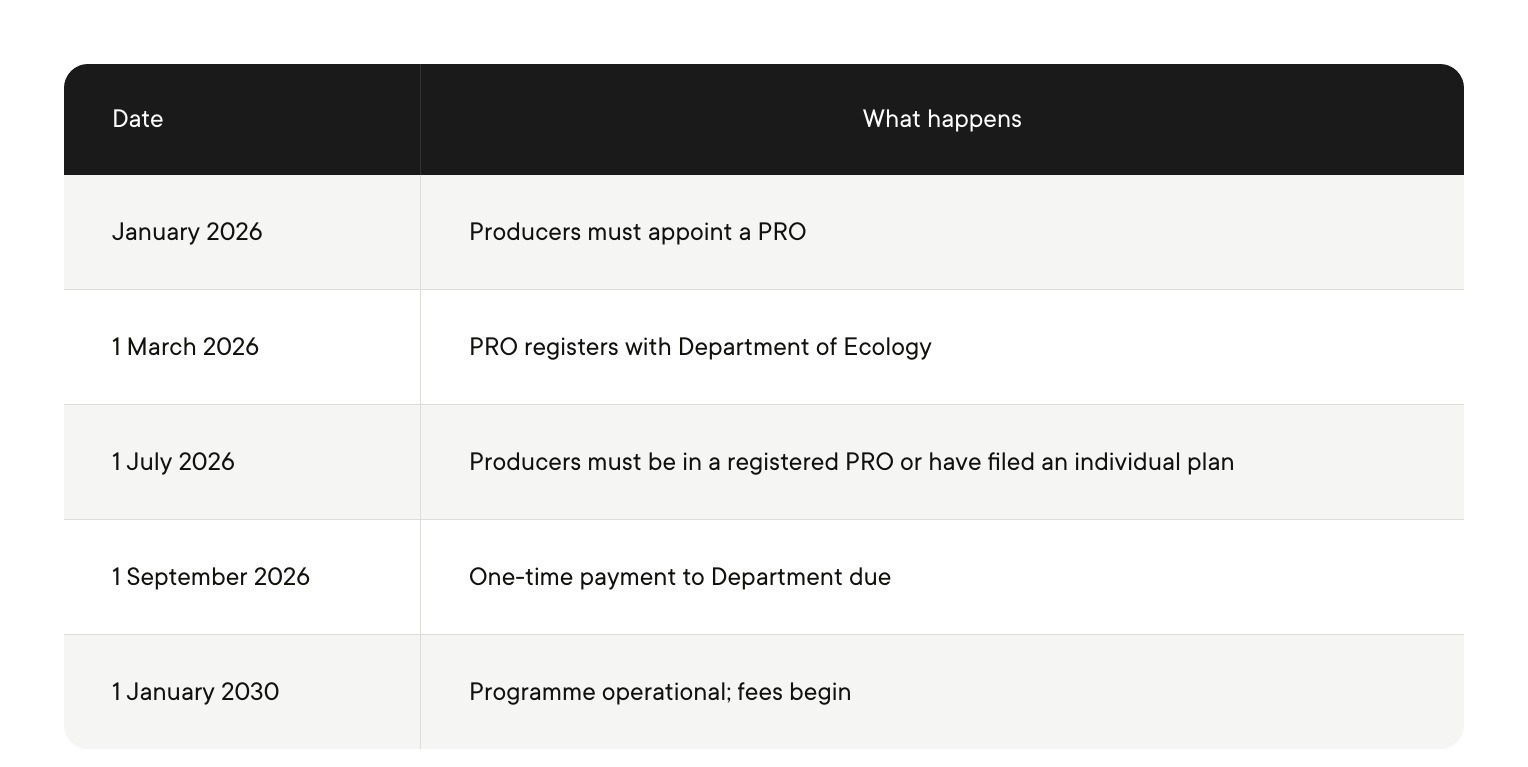
What to do now: Appoint CAA as your intended PRO for Washington by January 2026, pending formal approval. Monitor Department of Ecology announcements for the approved PRO list. Assess whether an individual compliance plan is appropriate for your business before July 2026.
What this means if you operate across the US
For brands selling nationally, the most important structural point is that the Circular Action Alliance is the PRO in five of the seven states. Registering once with CAA and maintaining a single reporting relationship covers Oregon, Colorado, California, Minnesota, and Maryland. Maine and Washington will likely follow a similar path once their PRO selections are confirmed.
The practical implication: your compliance overhead is lower than it might appear from seven separate state programmes. A single data collection and reporting process through CAA's portal, covering your packaging placed on market by state, satisfies most of your reporting obligations across the active programmes.
Fee apportionment. You pay fees based on the volume of packaging placed on each state's market, not your total US volume. You need sales or shipment data segmented by state to calculate your fee exposure per programme. If you use a 3PL or ERP system, this is typically extractable from fulfilment records. If you sell direct-to-consumer via e-commerce, shipping address data at the order level is your primary source.
The multi-state fee optimisation. Packaging design decisions made for California (the largest market) will typically carry through to Oregon, Colorado, and the others. A switch from a multi-layer flexible laminate to a mono-material or paper-based structure reduces your fee exposure in every state simultaneously. That multiplier effect of fee savings stacked across five or more programmes, changes the financial burden on packaging redesign significantly.
State-specific nuances worth flagging. Oregon's LCA pathway exists only in Oregon. Minnesota's PFAS malus is unique to Minnesota. California's 25% plastic reduction target creates a design obligation that goes beyond fee optimisation. If any of those three states represents a significant share of your market, they warrant separate attention beyond the cross-state framework.
Packaging data: what you need to track and how
EPR compliance is a data problem before it is a design problem. You cannot calculate your fee exposure, claim eco-modulation bonuses, or report accurately to CAA without a reliable record of what packaging you are placing on the market and where.
The data you need for each packaging component:
- Material type (aligned to CAA's CMC categories: plastic, paper, glass, metal, multi-material, etc.)
- Weight per unit (in kg or lbs) for each packaging component separately: primary packaging, secondary packaging, and e-commerce shipping materials
- PCR content percentage (required to claim eco-modulation bonuses in Colorado and, in future, other states)
- Recyclability status per CAA's current classification for your format
- Volume sold or shipped per state (to apportion your POM weight to each programme)
Where to get it:
Your packaging supplier is the primary source for material type, weight, and PCR content. Ask for a Bill of Materials (BOM) for each packaging SKU and request material certification documentation for any PCR content claim. CAA's reporting portal provides templates that define the exact data fields required. Use these templates to structure your data collection, not a bespoke internal format.
Start with your top 20% of SKUs by volume. In most packaging-intensive businesses, 20% of SKUs account for 80% or more of total packaging weight placed on market. Build your data collection process around the high-volume formats first. The long tail of low-volume SKUs matters for completeness, but the fee exposure is concentrated at the top.
Track changes as they happen. Every time you change a packaging format, update your BOM. The data you report to CAA reflects what you placed on market in the prior calendar year. An untracked material change creates reporting errors and potentially missed eco-modulation bonuses.
Designing for EPR
EPR creates a clear financial incentive to redesign packaging for recyclability. The packaging formats that attract the lowest fees are those accepted in kerbside recycling systems: corrugated cardboard, uncoated paper, rigid PET, aluminium. The formats that attract the highest fees are those that impose the greatest cost on municipal waste systems: multi-layer flexible laminates, coated paper, non-recyclable plastic film.
The design challenge is that recyclability under EPR is not theoretical. It is based on what is currently collected, sorted, and sold into verified end markets in each state. Mono-material polyethylene structures, for example, may be technically recyclable but are not on most states' collection lists because the kerbside infrastructure and end markets do not yet exist at scale.
This creates a genuine tension for flexible packaging brands. Your product may require barrier performance that only a multi-layer laminate can provide. Switching to paper may not be technically feasible for moisture-sensitive or shelf-stable products. Certified compostable films offer a mid-tier fee position where industrial composting infrastructure exists, but coverage is uneven.
What you can do within the current constraints:
The most defensible moves within today's infrastructure are:
- switching to certified mono-material structures where barrier requirements allow it (these will improve in fee position as infrastructure develops);
- adding verified PCR content to claim eco-modulation bonuses where they exist (Colorado, and likely others as programmes mature);
- lightweighting packaging to reduce the weight-based fee regardless of material classification
There is no single packaging design that solves EPR across all seven states simultaneously. Every format involves trade-offs between barrier performance, cost, recyclability, and fee position. The right design choice depends on your product requirements, your state-by-state volume profile, and your timeline for redesign.
What EPR does is make those trade-offs financially explicit. The fee is the price of the current design. The eco-modulation bonus is the financial value of a better one. Both are knowable before you make the investment.
EPR schemes also heavily favour recyclable materials, which can create pressure to move from lightweight flexible pouches toward heavier rigid plastic or glass formats. In some cases, this shift does lower the fee rate per pound, but it simultaneously increases total packaging weight, total material cost, overall carbon footprint, and shipping costs. A decision that looks favourable on the EPR fee sheet can quietly erode margin and sustainability credentials elsewhere.
Format transitions need to be modelled across the full cost picture, including EPR fees, material costs, weight, freight, and carbon, before committing. Optimising for one variable in isolation creates unintended consequences across the others.
Strategies to design for EPR
Fee exposure is not fixed. Packaging design decisions directly determine what brands pay. Four practical levers:
- Source Reduction: lightweighting your films (downgauging) or right-sizing pouches to reduce total weight placed on market
- Transition to Mono-Materials: moving from multi-layer laminates (PET/PE/Foil) to mono-material PE structures. Mono-materials are more likely to be classified as recyclable, triggering lower base fees and eco-modulation credits
- Eliminate Secondary Plastic: removing shrink bands, plastic windows, or unnecessary overwrap. In California, every removed plastic component directly reduces your component count metrics
- Incorporate PCR: post-consumer recycled content is a primary trigger for eco-modulated fee reductions in Colorado and California
How Grounded can help
Grounded works with the next generation of brands to achieve future-proof sustainable packaging solutions for their business. We ensure our brand's packaging works on the line, on the shelf, or under regulatory scrutiny.
We have mapped the EPR fee positions, recyclability classifications, and eco-modulation mechanics for the formats most relevant to flexible packaging brands: pouches, mailers, bags, wraps, and their paper-based and compostable alternatives.
If you are trying to understand whether a sustainable packaging switch is feasible for your product and your business, reach out to the Grounded team to discuss your packaging portfolio and EPR obligations.
Frequently asked questions
Do I need to register separately in each state?
For most states, no. The Circular Action Alliance is the PRO in Oregon, Colorado, California, Minnesota, and Maryland. One CAA registration covers all five programmes, and reporting is handled through a single portal. Maine and Washington will likely consolidate through CAA once their PRO selections are confirmed. You will need to apportion your packaging volumes by state within your CAA reporting, but the registration process itself is consolidated.
I am a small brand. Am I exempt from US packaging EPR?
It depends on the state. Maine has the most explicit thresholds: under $2 million annual revenue, or under 1 tonne of consumer packaging per year in Maine, you are fully exempt. Other states have small producer criteria set in program plan documents rather than statute. Check CAA's documentation for the current thresholds in Oregon, Colorado, and California. Minnesota mandates PRO membership for all producers with no small producer bypass in the statute. Do not assume exemption without confirming the current threshold for each state.
My packaging is already recyclable. Do I still pay fees?
Yes. All producers pay fees based on what they place on the market. Recyclable formats attract lower base fees and eco-modulation bonuses, but they are not free. The financial benefit of recyclable packaging is a lower fee position relative to non-recyclable formats, not a fee waiver.
My packaging uses a compostable flexible film. Does that reduce my fees?
It depends. Certified compostable flexible film typically qualifies for a mid-tier fee position rather than the highest tier for non-recyclable plastic. In California, it sits in a dedicated compostable classification. However, compostable plastic does not count toward California's 25% plastic reduction target. And in states where industrial composting infrastructure is limited, the fee benefit of compostable film over other non-recyclable formats may be modest. Always check the current classification in the state-specific CMC list or USCL.
When will the remaining states confirm their fee rates?
California will confirm rates when CAA's program plan is approved, ahead of the 2027 launch. Maine will confirm once the Stewardship Organization submits its program plan, expected in 2027. Washington and Minnesota will confirm in 2028 ahead of their respective operational dates.
Sources and further reading
- Oregon DEQ Plastic Pollution and Recycling Modernization Act: oregon.gov/deq
- CalRecycle SB 54 programme page: calrecycle.ca.gov
- Colorado CDPHE Producer Responsibility Program: cdphe.colorado.gov
- Maine DEP Stewardship Program for Packaging: maine.gov/dep
- Minnesota PCA packaging EPR resources: pca.state.mn.us
- Maryland MDE packaging EPR: mde.maryland.gov
- Washington Department of Ecology Recycling Reform Act: ecology.wa.gov
- Circular Action Alliance: circularactionalliance.org
- Seven-state EPR compliance guide (Proskauer Rose, 2025): proskauer.com
- EPR state update fall 2025 (Tonkon Torp): tonkon.com
Other posts you may like:
thumbnail.png)

Explore custom packaging solutions
Subscribe to our newsletter
Stay up to date with packaging news and industry updates.


.webp)