


June 4, 2026
Carbon 101: Understanding the Carbon Cycle, Greenhouse Gases, and where sustainable packaging fits in the picture
Humans emitted an estimated 38.1 billion tonnes of CO2 in 2025. A new record.
The atmosphere has not seen carbon concentrations this high in 3 million years.
Packaging is part of that story, a real and traceable part. And yet carbon remains one of the most underexplained topics in the industry. Reports assume you know what CO2e means. Certification schemes assume you understand embodied carbon. Retailer questionnaires assume you can map your Scope 3 emissions.
Most people are not carbon scientists. They shouldn't need to be. But a working understanding of how carbon moves through the atmosphere, and where sustainable packaging sits in that system, makes every subsequent decision sharper. This article builds that foundation from scratch.
The natural carbon cycle
Carbon is not a pollutant. It is one of the most fundamental elements in nature, cycling continuously between the atmosphere, land, oceans, and living organisms. Understanding how it moves through the natural world is the foundation for understanding why human-made emissions are a problem.
In the natural carbon cycle, plants and trees absorb carbon dioxide (CO2) from the atmosphere during photosynthesis, converting it into organic matter and releasing oxygen. When plants and animals die and decompose, or when animals exhale, carbon returns to the atmosphere. Oceans absorb enormous quantities of CO2 directly from the air. Over millions of years, some organic matter was buried and compressed under geological pressure, becoming coal, oil, and natural gas. This is carbon locked away from the active cycle for hundreds of millions of years.
The result is a system broadly in balance over geological timescales. Carbon moves between reservoirs, but the amount in the atmosphere stayed within a range that kept the planet's temperature stable enough to support life as we know it.
The fossil carbon problem
The problem began with the Industrial Revolution. When humans started burning fossil fuel for energy, carbon that had been locked underground for hundreds of millions of years began moving into the atmosphere as carbon dioxide (CO2) in a matter of decades. This is not part of the natural short-term carbon cycle. It is a one-way transfer of ancient carbon into the active atmosphere.
The scale is significant. The Global Carbon Budget 2025 estimated CO2 emissions from fossil fuels at 38.1 billion tonnes in 2025, a new record high. The oceans and land vegetation absorb roughly half of what we emit, but the remainder accumulates in the atmosphere year after year.
The consequence of this is a sustained rise in atmospheric CO2. The climate crisis is a direct result of more fossil fuels in our atmosphere - creating an imbalance in our carbon cycle.
To prevent the worst outcomes from climate change we need to limit global warming to 1.5 degrees celsius (As set by the Paris Agreement). To achieve this we have to cut carbon emissions in half by 2030. That is global net human-caused emissions of carbon dioxide (CO2) would need to fall by about 45% from 2010 levels by 2030.
Greenhouse gases: CO2 is not the only one
Greenhouse gases (GHGs) trap heat in the atmosphere by absorbing radiation that would otherwise escape to space, then re-emitting it in all directions, including back toward Earth's surface. Without any greenhouse gases, Earth would be approximately 33 degrees Celsius colder. The problem is not the existence of GHGs, but their rapid increase.
Other Greenhouse gases you may have heard of before also include methane (i.e. natural gas leaks) and nitrous oxide (fertilisers).
Other greenhouse gases have a larger global warming potential (GWP) than carbon dioxide. Methane, for example, has a GWP of 28x of carbon dioxide. And nitrous oxide? 273x of CO2.
What is CO2e?
CO2-equivalent (CO2e) is a standardised unit that expresses the warming impact of any combination of greenhouse gases, relative to CO2 over a 100-year period.
This is why you will see carbon footprints expressed in kilograms of CO2e per unit, or tonnes of CO2e per year, rather than CO2 alone.
A brand's packaging carbon footprint includes not just the CO2 from manufacturing, but also methane from natural gas used in production processes, nitrous oxide from agricultural feedstocks for bio-based films, and any other GHGs generated across the supply chain. CO2e brings all of these into one comparable figure.
The global picture in 2025
To understand the scale of the challenge, here are the current benchmarks.
- 38.1 Gt CO2. Fossil fuel CO2 emissions in 2025, a new record
- 1.5°C. 2024 was the first calendar year on record to average more than 1.5°C above pre-industrial levels, the threshold identified in the Paris Agreement as a key risk boundary.
The remaining carbon budget to limit warming to 1.5°C with a 50% probability will be exhausted within approximately six years at current emission rates. Packaging sustainability decisions are not disconnected from this picture. They are part of it.
Where does packaging fit in the carbon picture?
Packaging is estimated to account for approximately 5% of global greenhouse gas emissions. For consumer goods brands, packaging typically represents one of the largest individual sources of carbon within their value chain.
The carbon footprint of packaging comes from several sources.
- Raw material extraction and production is typically the largest contributor
- Manufacturing energy, meaning the electricity and heat used in printing and manufacturing, is the second major source.
- Transport of raw materials and finished packaging adds a further contribution.
- End-of-life, whether packaging goes to landfill, is incinerated, or is recycled, determines the final accounting.
The carbon trade-offs in flexible packaging
Flexible plastic packaging has a complicated but often favourable carbon position relative to paper and rigid alternatives.
The two primary drivers are material efficiency and transport. A flexible stand-up pouch uses significantly less material by weight than the equivalent rigid container. Less material means less energy in production and less weight to transport.
Transport emissions are directly proportional to weight, and the low mass of flexible packaging means more product can be moved per freight load. A 2025 study found that the heavy weight of glass consistently undermines its environmental performance relative to light plastics.
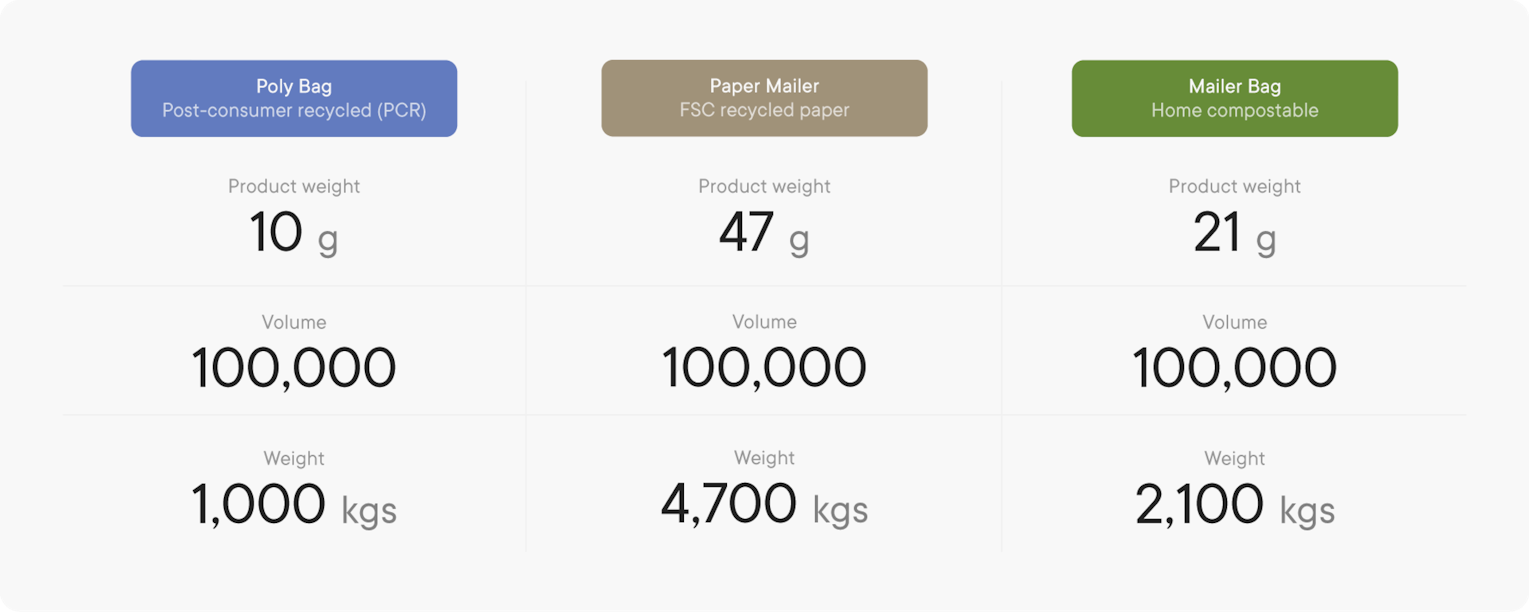
We receive a similar result when comparing a plastic garment poly bag to a compostable or paper alternative.
Life cycle assessments consistently find that flexible packaging generates lower carbon emissions per unit of product than glass, many metal formats, and some rigid plastic alternatives, even accounting for the lower recyclability of flexible film at end of life.
Post-consumer recycled (PCR) content creates a distinct carbon saving: at the start of life, before the packaging is manufactured. Every kilogram of virgin plastic resin requires fossil fuel. PCR content displaces that entire upstream chain.
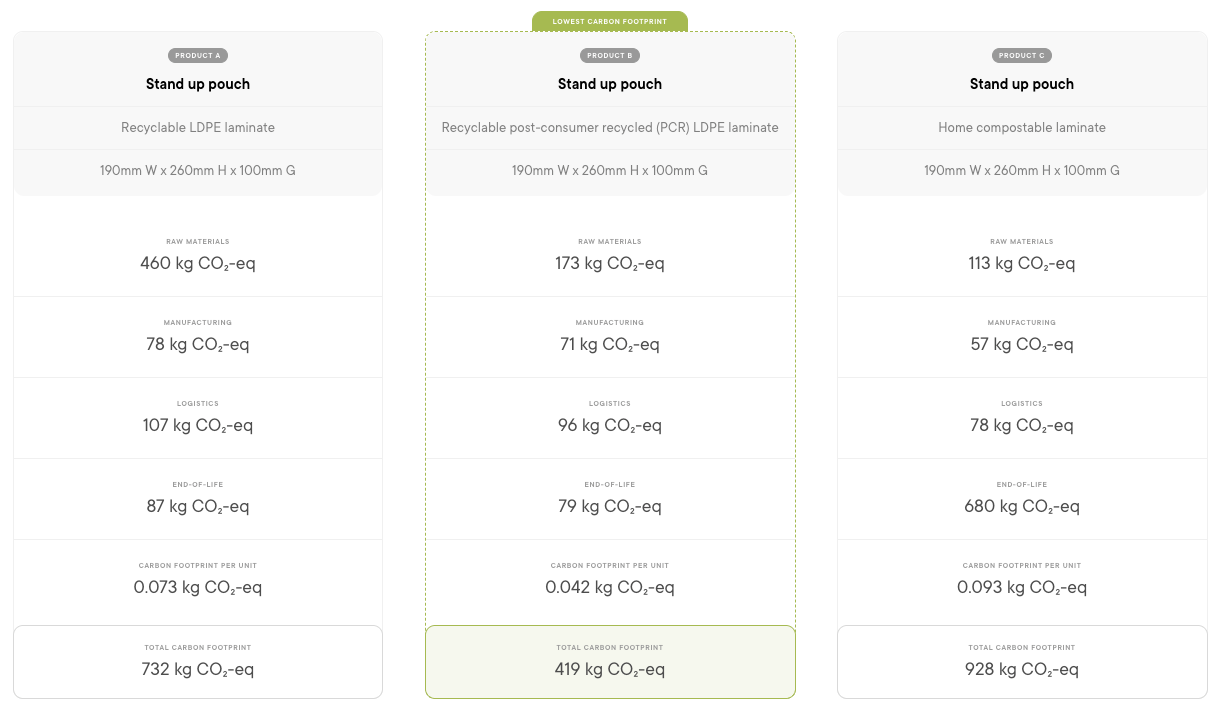
Comparing an all virgin LDPE pouch, with a post-consumer recycled pouch, we see an 80% reduction of reliance on fossil fuels.
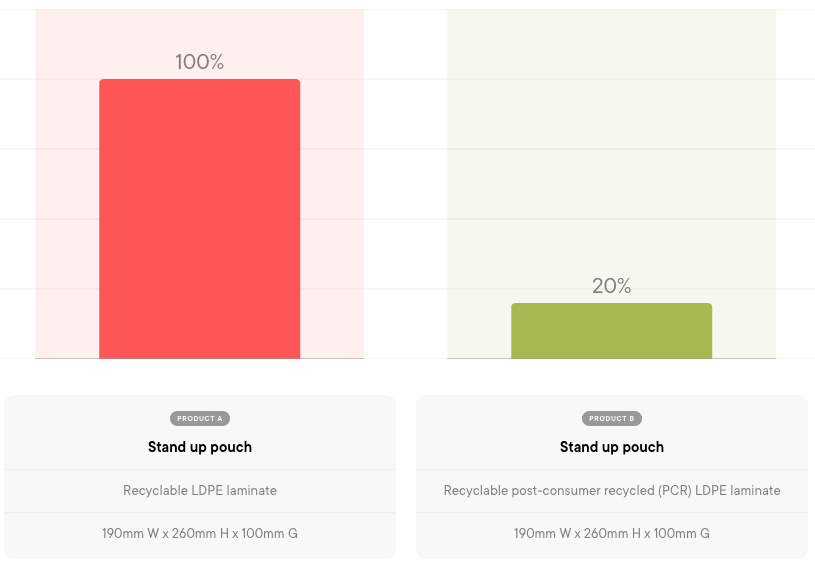
Recyclability and recycled content are related but distinct levers. Recyclability creates the feedstock supply for future cycles. Recycled content creates the market demand that makes collecting and processing that feedstock economically viable. Both are necessary for the circular economy to function, and your packaging carbon footprint benefits from both.
READ MORE: On an in-depth review of Recycled vs. Recyclable
The carbon story for flexible packaging is about the whole lifecycle, not one attribute. A 2024 study examined circular economy approaches to flexible plastic packaging and found that recycled content and end-of-life recovery are the two levers with the greatest potential to reduce lifetime GHG impact.
What this means for you and your brand
Carbon literacy is a commercial skill. Retailers are asking for Scope 3 data. Regulators are tightening requirements on packaging claims. Consumers are scrutinising what brands put on pack. None of that is navigable if you do not understand what CO2e means, where your packaging's carbon comes from, or why the format and material choices you make today have consequences that run from fossil extraction through to end-of-life.
READ MORE
Grounded has long backed the notion that, while there is no perfect silver bullet for packaging solutions, there are always data-backed metrics that provide the right guidance for your business. Read our review of the five sustainability metrics that matter here.
Frequently asked questions
What is the difference between carbon and carbon dioxide?
Carbon (C) is a chemical element. Carbon dioxide (CO2) is a molecule made of one carbon atom bonded to two oxygen atoms. When we talk about carbon emissions in the context of climate, we almost always mean CO2 and other greenhouse gases expressed as CO2-equivalent (CO2e). The shorthand "carbon" is standard in business and policy contexts to mean CO2 or CO2e, even though technically they are distinct things.
Is CO2 always harmful?
No. CO2 is a natural and essential part of the carbon cycle. Plants need it for photosynthesis. The Earth's natural greenhouse effect, partly driven by CO2, is what makes the planet habitable. The problem is the rapid increase in atmospheric CO2 concentration caused by burning fossil fuels, which is disrupting the climate system at a pace too fast for natural systems to adapt.
Why is methane more concerning than CO2 if there is less of it in the atmosphere?
Methane is far more potent than CO2 on a weight-for-weight basis. The IPCC puts methane's 100-year global warming potential at approximately 28x that of CO2 for biogenic sources and 29.8x for fossil-sourced methane. Although there is far less methane in the atmosphere than CO2, its potency means it accounts for around 16% of the total warming effect from long-lived greenhouse gases.
Does flexible packaging have a lower carbon footprint than rigid packaging?
It depends on the comparison, but flexible packaging generally has a lower carbon footprint than glass and many metal formats on a per-unit-of-product basis. The primary driver is material efficiency: flexible packaging uses far less material by weight and is significantly more transport-efficient. Compared to rigid plastic, the comparison is more nuanced and depends on the specific formats being compared. LCA studies that account for raw material production, manufacturing energy, transport, and end-of-life consistently find flexible packaging performing well on a carbon basis despite its end-of-life recycling challenges.
What is the Paris Agreement and why is 1.5°C the threshold?
The Paris Agreement, adopted in 2015 by 196 countries, commits signatory nations to limiting global average temperature rise to well below 2°C above pre-industrial levels, with efforts to limit it to 1.5°C. The 1.5°C threshold was identified by climate scientists as the point beyond which risks of severe climate impacts, including extreme weather events, sea level rise, and ecosystem disruption, increase significantly. In 2024, the global average temperature exceeded 1.5°C above pre-industrial levels across a full calendar year for the first time on record.
What are Scope 3 emissions and why do retailers ask packaging suppliers about them?
Scope 3 emissions are the indirect emissions across a company's value chain, including the packaging it buys. Because packaging is often one of a consumer brand's largest single carbon sources, retailers increasingly request Scope 3 packaging data to meet their own reporting and disclosure requirements.
Sources and further reading
- ACS Applied Polymer Materials. (2025). Sustainable enhanced regeneration and properties analysis of waste LLDPE films. https://pubs.acs.org/doi/10.1021/acsapm.5c04215
- Lin, X. et al. (2026). Dramatic increase in ecosystem respiration causes record-breaking atmospheric CO2 growth rate in 2024. Nature Communications. https://www.nature.com/articles/s41467-026-72189-y
- IEA. (2025). Global Energy Review 2025: CO2 Emissions. https://www.iea.org/reports/global-energy-review-2025/co2-emissions
- Dolci, G. et al. (2025). How does plastic compare with alternative materials in the packaging sector? A systematic review of LCA studies. Waste Management & Research. https://pmc.ncbi.nlm.nih.gov/articles/PMC11874595/
- Zheng, L. et al. (2024). Life cycle assessment of packaging systems: A meta-analysis to evaluate the root of consistencies and discrepancies. Journal of Cleaner Production. https://www.sciencedirect.com/science/article/pii/S0959652624032347
- Global Carbon Budget 2023. (2024). Earth System Science Data. https://globalcarbonbudget.org/
Other posts you may like:
thumbnail.png)

Explore custom packaging solutions
Subscribe to our newsletter
Stay up to date with packaging news and industry updates.


.webp)