

Packaging Design
Material Differences
Rotogravure vs Digital Printing for Flexible Packaging: What's Right for Your Brand?
Key takeaways
Rotogravure and digital are the two dominant printing technologies for flexible packaging. Both produce high-quality, commercially viable packaging. Where they differ is in where each one is efficient, what they cost, and the trade-offs each introduces for smaller or growing brands. This guide compares them on the factors that matter for FMCG, coffee, and e-commerce brands, and gives you a framework for choosing.
Quick answer: what is the difference between rotogravure and digital printing?
Rotogravure uses engraved metal cylinders, one per colour, to transfer ink onto film. The cylinders are expensive to produce but deliver consistent, photographic-quality results across very long runs. Digital printing prints straight onto film from the artwork file, with no cylinders, no plates, and no minimum run length tied to recovering tooling costs.
The short of it, is:
- Choose gravure when you are printing very large volumes of a stable design.
- Choose digital when you need shorter runs, fast turnarounds, or the ability to change artwork without retooling.
What is rotogravure printing?
Rotogravure is an intaglio process. The image is engraved into a copper cylinder, which is chrome-plated for durability. As the cylinder rotates through an ink bath, ink fills the engraved cells, a blade wipes the surface clean, and the ink transfers onto the film under pressure.
Each colour needs its own cylinder, and that tooling drives gravure's economics:
- Tooling cost: roughly $120 to $200 USD per cylinder. A six to eight colour design carries $1,000 to $1,600 USD in tooling before a single unit is printed.
- Fixed regardless of volume: the more units you spread it across, the lower the per-unit cylinder cost. Cylinders are reused on repeat runs of the same design.
- Cost-efficient at scale: typically 20,000 to 500,000 units and above, depending on format. Below those thresholds it gets expensive relative to digital.
What gravure delivers in return:
- Extremely high colour accuracy and sharp definition, including fine gradients, photographic imagery, and small text.
- Press speeds of 300 to 500 metres per minute, the most efficient technology at genuine scale.
For brands with stable designs and high-volume, repeatable runs, it is the industry standard for good reason.
What is digital printing for flexible packaging?
Digital printing works on the same principle as commercial inkjet or laser printing, scaled for industrial film. There are no cylinders and no plates. The artwork file goes straight to the press, which prints it in a single pass using water-based or UV-curable inks.
With no tooling, there are no traditional setup costs. You pay for the run itself, not for preparing the equipment, which changes the maths for shorter runs. A 5,000-unit custom pouch run is viable on digital in a way it is not on gravure.
Modern digital presses now match gravure on colour gamut and resolution for most commercial applications. Gravure still leads on very fine detail, exact Pantone spot matching on certain substrates, and per-unit cost at genuinely high volumes.
The practical advantages of digital for growing brands:
- No tooling costs: You are not committing thousands of dollars to cylinder engraving before you know how a SKU will perform.
- Short minimum order quantities: Runs of 1,000 to 10,000 units are viable, which suits seasonal variants, limited editions, launches, and market testing.
- Fast turnaround: No cylinder lead time (usually two to four weeks), so jobs move from approved artwork to finished packaging in days.
- Easy artwork evolution: Changing artwork, text, or SKU details costs nothing in tooling, and you can run multiple variants in a single session. This is what makes short-run personalisation and co-branding affordable.
The key differences: gravure vs digital printing for flexible packaging
Minimum order quantities and run length
The most important factor for most brands. Gravure is cost-efficient at high volumes; digital at low to mid volumes. The crossover varies by format, colour count, and supplier, but as a working guide:
- Below 20,000 units per SKU per run: digital is typically more cost-effective.
- Above 50,000 to 100,000 units per SKU per run: gravure typically becomes competitive or advantageous per unit.
- Between those bands: it depends on the job, artwork complexity, and supplier pricing.
For brands early in growth, or running multiple SKUs at modest volumes, digital removes the financial barrier gravure's tooling imposes.
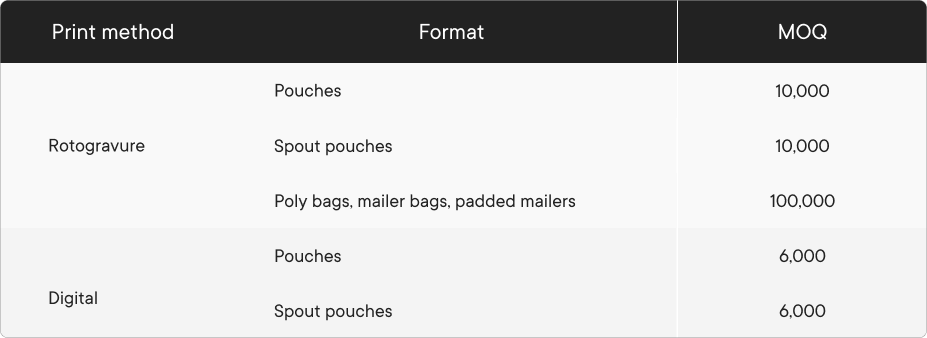
Minimum order quantities by print method at Grounded Packaging
For laminates including pouches such as stand up pouches, flat bottom pouches, and spout pouches, minimum order quantities start at 6,000 for digital print, and 10,000 for rotogravure. For films like mailer bags and poly bags, minimum units are 10,000 for digital, and 20,000 for rotogravure.
Minimum order quantities vary by format and dimensions, and given the custom nature of flexible packaging, should be treated as a guide rather than a fixed figure.
Setup costs and tooling
- Gravure: $120 to $200 per cylinder, one per colour. An eight-colour job costs $1,000 to $1,600 before production. Cylinders are reused on repeats, so amortised cost falls with volume. Any artwork change needs new cylinders.
- Digital: no tooling costs. Artwork changes cost nothing in preparation. Each run's full cost is the per-unit print cost.
Print quality and colour accuracy
Both produce commercially excellent packaging. The difference is at the edges:
- Gravure leads on photographic reproduction, very fine detail, and Pantone spot matching on certain substrates. For packaging that is a primary brand expression (specialty coffee, premium food, personal care), its quality ceiling is higher.
- Digital is indistinguishable in normal retail conditions for most FMCG, e-commerce, and food-service packaging. The visible gap remains only in very fine gradients, extreme detail, and critical colour accuracy.
If a specific Pantone must be matched precisely across every run and market, gravure is more reliable. If your packaging is commercially competitive but not dependent on sub-millimetre precision, digital is entirely adequate.
Turnaround time
- Gravure: cylinder engraving adds two to four weeks for new or revised artwork. Repeat runs on existing cylinders are faster.
- Digital: no cylinder lead time. Approved artwork to production start in one to three days, typically two to four weeks faster than gravure for new designs.
A real advantage for brands launching products, chasing seasonal opportunities, or correcting artwork quickly.
Customisation and versioning
- Gravure: each artwork change needs new cylinders, so running multiple variants multiplies tooling cost. Efficient for high volumes of one stable design, expensive for variety.
- Digital: multiple variants run with no extra tooling. Print 2,000 of one flavour, 2,000 of another, and 1,000 of a seasonal variant in the same session at no added setup cost.
When gravure is the right choice
Gravure makes sense when:
- Volumes are high enough to amortise tooling efficiently (around 200,000 units or more of the same SKU per run).
- The design is stable across long runs.
- Colour accuracy and print definition are critical to the brand.
- Per-unit cost efficiency is the primary driver and the packaging is a premium brand asset requiring consistent photographic quality.
When digital is the right choice
Digital makes sense when:
- You are launching a product and do not want to commit tooling before validating volume.
- Run sizes are below 20,000 units.
- You need multiple SKU variants or seasonal artwork.
- Lead times are tight, or you want to test a design before long-run production.
For most small to mid-size FMCG brands, specialty coffee roasters, and e-commerce brands building a range, digital removes the barriers gravure imposes at early and growth stages. It also suits sustainable packaging ranges, where short-run flexibility allows iterative testing of new materials without large volume commitments.
What this means for you and your brand
The gravure vs digital decision is primarily a volume and flexibility trade-off. At scale, gravure is efficient and delivers a quality ceiling digital has not fully matched. At the volumes and growth stages most independent FMCG, coffee, and e-commerce brands operate at, digital's flexibility, lower tooling costs, and faster turnaround tend to outweigh gravure's per-unit economics.
The right answer depends on your run volumes, the stability of your artwork, how many SKUs you manage, and how much weight you place on per-unit cost versus flexibility. If you are choosing a print method for the first time, or reviewing whether your current one still fits your volume profile, speak to our team. The right choice is almost always specific to where you are in your growth cycle, not a universal recommendation.
Frequently asked questions
What is rotogravure printing?
An intaglio process where the image is engraved into a copper cylinder. The cylinder picks up ink in its engraved cells and transfers it to film under pressure, with a separate cylinder per colour. It produces high-quality, consistent results at high volumes but carries significant cylinder tooling costs that make it less efficient for short or variable runs.
Is digital printing good enough for premium flexible packaging?
For most commercial applications, yes. Modern digital presses match gravure in normal retail conditions. Gravure keeps an edge in very fine detail, exact Pantone spot matching on certain substrates, and per-unit economics at high volumes. For specialty coffee pouches, FMCG food packaging, and e-commerce mailers, digital is entirely adequate and often preferable for the flexibility it provides.
What are the minimum order quantities for digital vs gravure flexible packaging?
Digital has no tooling-driven minimum; practical minimums are set by production economics, and runs of 1,000 to 5,000 units are viable on most lines. Gravure's effective minimum is driven by recovering cylinder costs, pushing viable minimums to 20,000 to 50,000 units or more. Below that, gravure's tooling cost per unit is hard to justify against digital.
Thanks. Your checklist is ready:
Download the checklist →Something went wrong. Please try again or email hello@groundedpackaging.co
Frequently asked questions
No items found.
Talk to a specialist
Not sure where your packaging lands?
Get a recyclability and EPR fee review of your current formats.
Not sure how your packaging will rate under EPR and PPWR?
Our packaging specialists can review your formats against the UK RAM ratings and EU PPWR design rules.
Talk to a packaging specialistthumbnail.png)
Subscribe to our newsletter
Stay up to date with packaging news and industry updates.


.webp)